


Patch Prioritization was never the strategy. It was the rationing.

CVSS, EPSS, and KEV were built to ration limited patching capacity against a slow-moving threat. That threat isn't slow anymore. This piece argues that in a compressed-window world, prioritization has to become a routing decision, not a ranking exercise - and that the real bottleneck was never analytics; it was velocity.
Patch Prioritization was never the strategy. It was the rationing.
Risk-based patching solved a real problem. It is now solving yesterday's problem, while the window it was designed to manage has quietly closed.
Every vulnerability management conversation right now sounds the same. Risk-based patching. Contextual scoring. Reachability analysis. Exploit prediction. Threat-informed prioritization. The vendor pitches differ in vocabulary but converge on one promise: we will tell you which 3% of your vulnerabilities actually matter, so you can stop drowning.
It is a good promise. It solved a real problem. And it is now solving yesterday's problem while a different one eats the industry alive.
The uncomfortable question nobody asks in these discussions is this: what were we prioritizing for? We were prioritizing because we could not patch everything in time. Prioritization is what you build when your remediation capacity is fixed and your vulnerability inflow is not. It is a rationing mechanism. A sophisticated one, well-engineered, backed by good data science. But rationing all the same.
And rationing only works when the thing you are rationing against moves slowly enough to be rationed.
How we got here
The logic of risk-based patching was sound when it emerged. CVSS base scores were producing thousands of "criticals" that were not critical in any operational sense. A 9.8 on a service you have disabled, behind three layers of network segmentation, on a host that faces nothing, is not a 9.8 to you. Teams were burning enormous effort on vulnerabilities that no attacker would ever reach.
So the industry built better filters. EPSS gave probabilistic exploitation likelihood. CISA's Known Exploited Vulnerabilities catalog gave ground truth on what was actually being used in the wild. Reachability analysis in software composition scanning cut through the noise of transitive dependencies nobody ever calls. Asset criticality scoring layered business context on top. Each of these was a genuine improvement, and together they turned an unmanageable queue into a manageable one.
The implicit model underneath all of it was a race with a comfortable head start. A patch drops. Somewhere between a few days and a few weeks later, a proof of concept appears. Some time after that, it gets weaponized and folded into commodity tooling. Mass exploitation follows. That timeline gave defenders room to think. You could triage on Tuesday, schedule for the following maintenance window, and still land inside the window.
That model is breaking, and it is breaking asymmetrically. Not for everything, but for exactly the things that hurt most.
The window closed
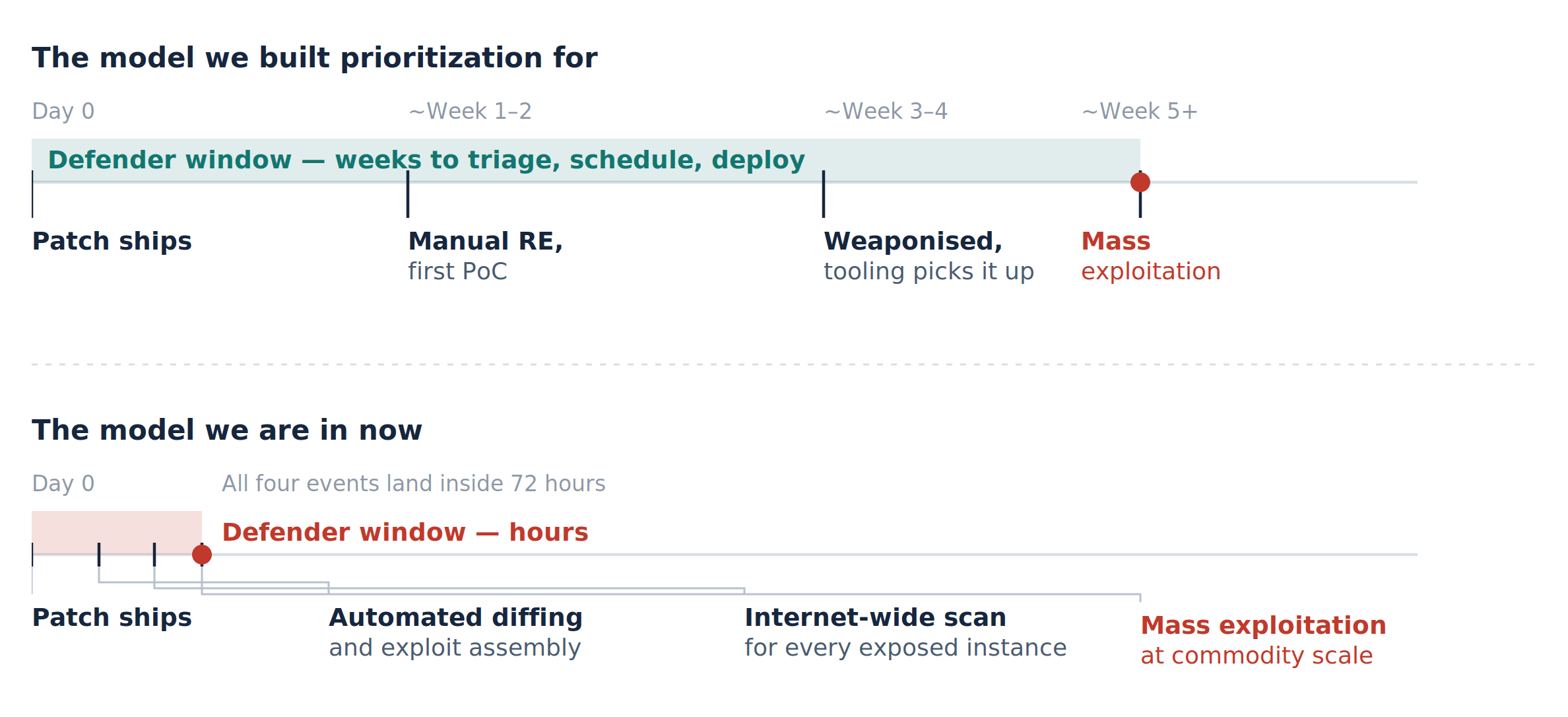
Figure 1. The compression. Ranking a queue made sense when the buffer between disclosure and exploitation was measured in weeks. For internet-facing software, that buffer is now frequently measured in hours.
Consider what has happened to the patch-to-exploit pipeline.
Patch diffing was once specialist work. You needed reverse engineering skill, patience, and familiarity with the target codebase to look at a binary before and after and figure out what was fixed. That skill was scarce, which meant the time between a vendor releasing a fix and someone building a working exploit from it was a natural buffer for defenders.
That buffer is thinning. Automated analysis of patch diffs, LLM-assisted code understanding, and increasingly capable fuzzing and exploit generation tooling are all pushing in the same direction. The specialist knowledge is being commoditized. A task that took a skilled researcher a week now takes considerably less, and it takes less skill to attempt.
At the same time, the discovery side has industrialized. Internet-wide scanning is cheap. Identifying every exposed instance of a given product globally is a routine operation, not a research project. The gap between "an exploit exists" and "every reachable instance has been tried" has compressed to something close to zero.
Look at the recent pattern with edge devices. VPN concentrators, file transfer appliances, network security gateways. The rhythm is consistent: disclosure, then mass exploitation measured in days, sometimes in hours, sometimes with exploitation preceding disclosure entirely. MOVEit was not a story about patch prioritization failure. Log4Shell was not a story about insufficient scoring nuance. These were velocity events. Organizations that survived them well did so because they could move, not because they ranked well.
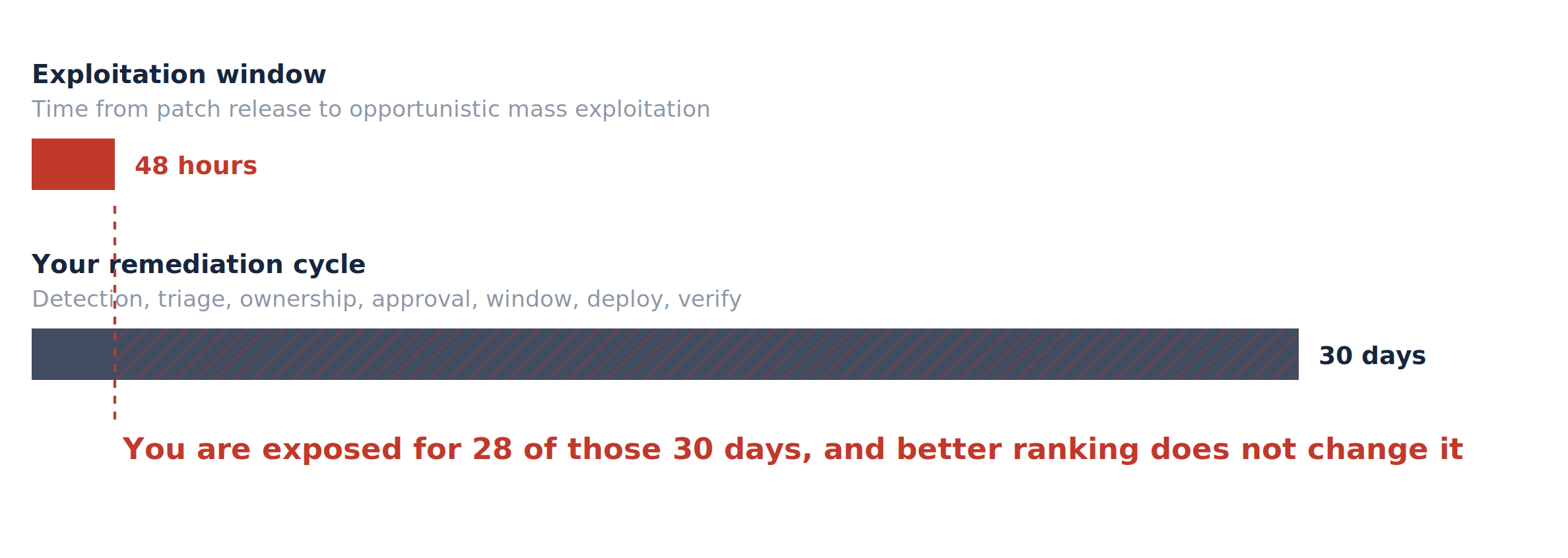
Figure 2. The arithmetic. If the exploitation window closes before your remediation cycle completes, prioritization only changes which fire you lose first. The hatched region is the part of the cycle that happens after the attacker has already arrived.
If your remediation cycle for a critical internet-facing vulnerability is 30 days, and the exploitation window is 48 hours, then better prioritization changes nothing about the outcome. You will have correctly identified the thing that is about to compromise you, and then you will watch it happen on schedule.
The number nobody measures
Ask a security team how good their prioritization is and they will show you a model. Ask them about their patching performance and they will show you SLA compliance and percentage-patched dashboards.
Both of those are compliance metrics. They tell you whether you met a target you set for yourself. They do not tell you what you are capable of.
The capability question is different: if a critical vulnerability lands tomorrow in something you run everywhere, how many hours until it is gone from the fleet? Not the SLA. The actual physical maximum, if the CISO stood behind you and cleared every obstacle.
Most organizations have never measured this. They have never tried. They know their average, which is governed by process friction, and they assume the emergency case is some faster version of the average. It usually is not. Emergency patching typically routes around the normal process entirely, which means it depends on heroics, tribal knowledge, and whoever happens to be awake. It is unrehearsed, and unrehearsed capability is not capability.
The organizations that handle these events well have almost always done two things. They have measured their true velocity ceiling, and they have practiced hitting it. The same way you do not discover your incident response plan is broken during an incident, you should not discover your emergency patch path is broken during a zero-day.
The bottleneck is not the decision
Here is what I think is the most important observation in all of this. When patching goes slowly, the delay is almost never in deciding what to patch.
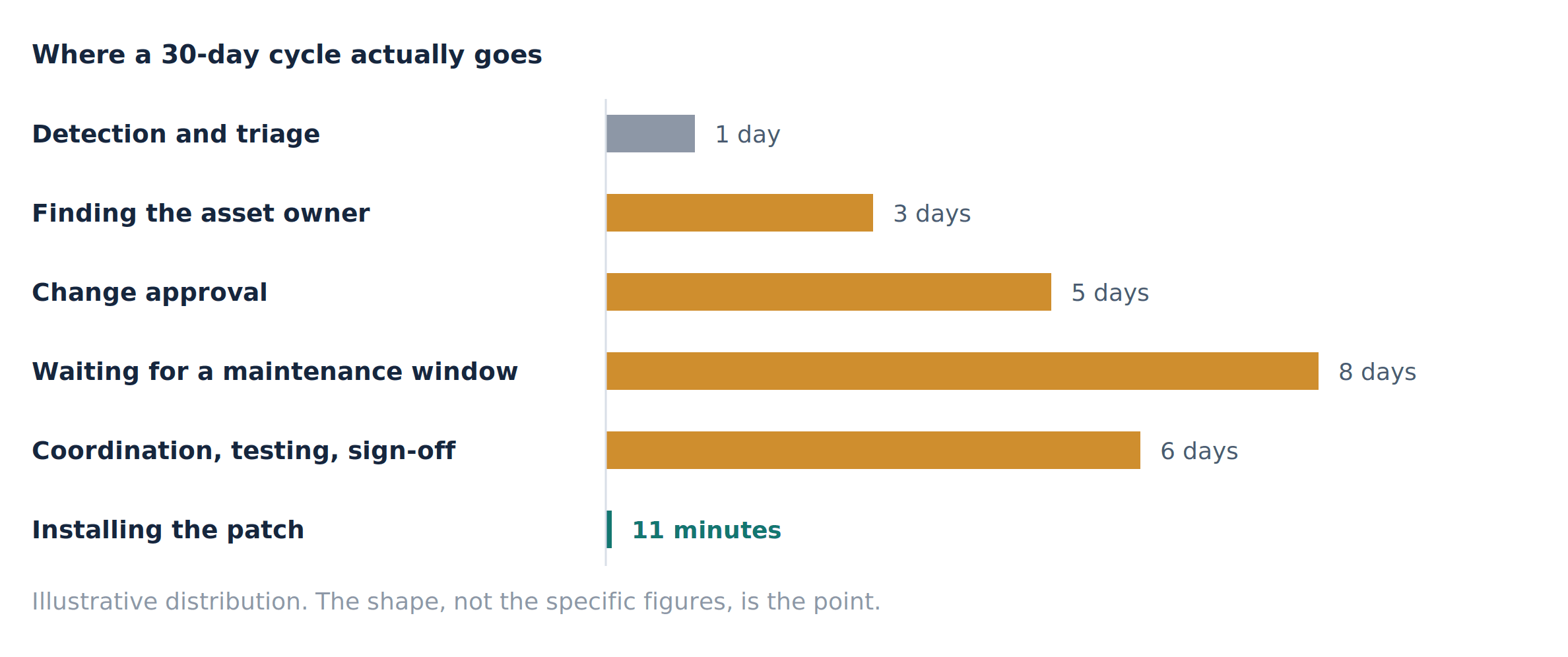
Figure 3. The work is not the wait. In most enterprises the technical act of patching is trivial. Everything expensive sits in discovery, ownership, approval and coordination - none of which a scoring engine touches.
The delays are somewhere else entirely:
- You do not know the asset exists. Shadow IT, forgotten infrastructure, an appliance a team stood up in 2019, a subsidiary's environment nobody has fully mapped. No prioritization engine helps you patch a server you cannot see. This remains, unglamorously, the single largest cause of patch failure in most enterprises.
- You do not know who owns it. The vulnerability is identified, the patch exists, and three days evaporate finding a human who can approve a restart. Ownership data is stale, the person listed left the company, and the ticket bounces between teams.
- You are afraid of breaking production. Legitimately, sometimes. A patch that takes down a revenue system is a real cost. But this fear is frequently uncalibrated, based on one bad experience years ago, and it functions as a permanent tax on velocity.
- Coordination overhead swamps the work. The actual patch takes eleven minutes. Getting change approval, finding a window, notifying stakeholders, arranging rollback, and confirming with the application team takes eleven days.
Notice that none of these are analytical problems. They are inventory problems, organizational problems, and engineering problems. The industry has poured enormous investment into prioritization partly because prioritization is tractable and demoable, while the actual constraints are messy, political, and specific to each organization.
If you are choosing where to spend the next budget cycle, an accurate asset inventory with reliable ownership mapping will do more for your risk posture than another layer of scoring sophistication. It is a less exciting purchase. It is the right one.
Speed and stability are not opposed
The instinctive objection to everything above is that moving faster means breaking more. It feels obviously true. It is largely false, and we have had good evidence against it for a decade.
The DORA research on software delivery performance found repeatedly that elite-performing organizations deploy far more frequently and have lower change failure rates and recover faster when things do break. Speed and stability move together.
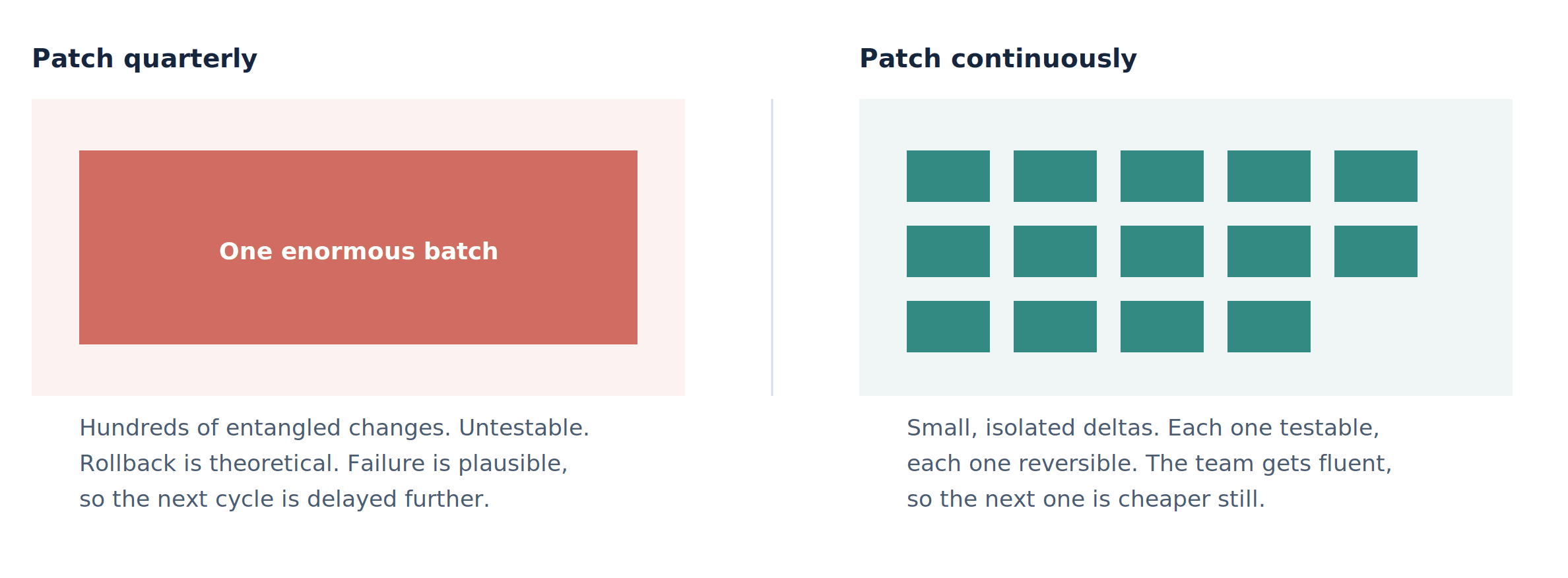
Figure 4. Caution creates the risk it fears. Slow patching is usually defended in the language of stability, but it accumulates exactly the kind of large, entangled change that is genuinely dangerous to apply.
The mechanism is not mysterious. Frequent deployment forces small batches, and small batches are easier to test, easier to reason about, and easier to roll back. Automated pipelines catch regressions that manual processes miss. Teams that deploy constantly get good at deploying.
Patching is deployment. The same physics apply. An organization that patches quarterly is not being careful; it is accumulating an enormous, entangled batch of changes that genuinely is dangerous to apply. The caution creates the risk that justifies the caution. Meanwhile the organization patching weekly is applying small, well-understood deltas with a rollback path it has exercised recently.
Slow patching is frequently a symptom of missing engineering capability: no automated testing, no ring-based or canary deployment, no confident rollback, no infrastructure as code. Those are fixable, and fixing them buys you both speed and safety at once.
Mitigation velocity, not patch velocity
One honest constraint: you cannot patch faster than your vendor ships a fix. For a zero-day under active exploitation, the vendor patch may be days away. Sometimes weeks.
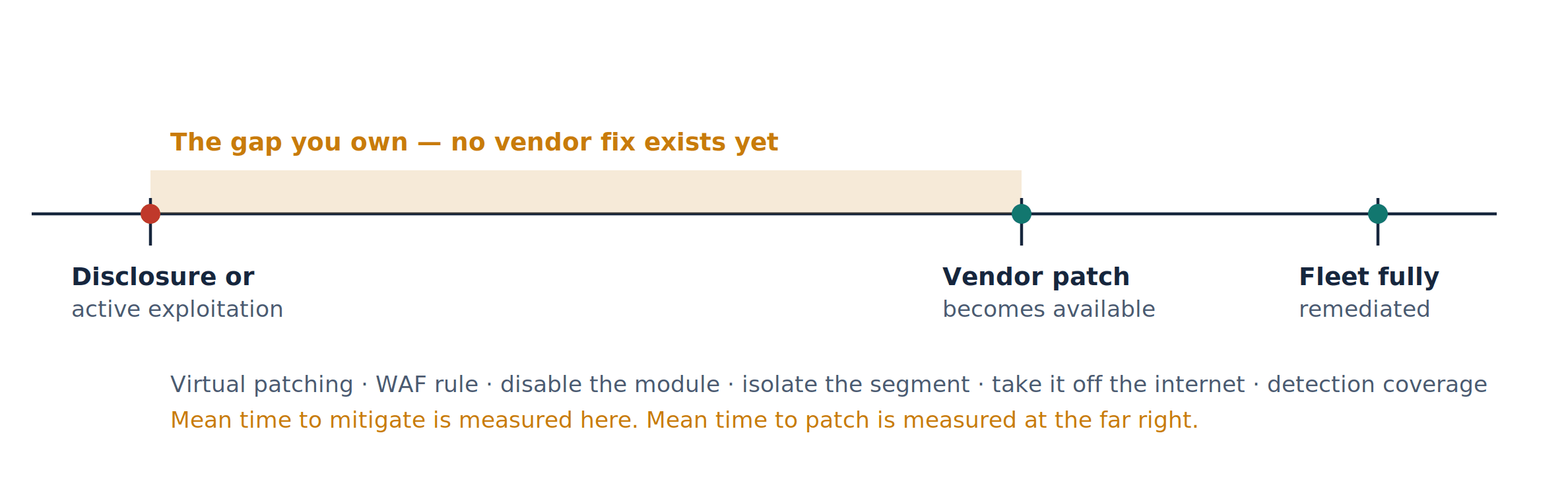
Figure 5. Measure mitigation, not patching. Every capability in the amber band has to exist before you need it. The test is whether you can push a blocking change to production at 2am without convening a committee.
This is why the right metric is mean time to mitigate, not mean time to patch. Your options in the gap are real ones. Virtual patching at the WAF. Disabling the vulnerable feature or module. Network isolation of the affected system. Blocking the exploit path at the proxy. Compensating detection rules that at least give you visibility if someone tries. Taking the thing off the internet entirely until the fix arrives.
Reporting MTTM instead of MTTP also changes the conversation with leadership, because it measures the thing that actually determines whether you get compromised.
What prioritization becomes
None of this means risk scoring is dead. It means its job changes.
Speed applied indiscriminately is expensive. Every emergency change consumes organizational goodwill, pulls engineers out of planned work, and adds operational risk. If you invoke emergency procedures for vulnerabilities that turn out to be unreachable or unexposed, you will exhaust the credibility you need for the one that matters. The boy who cried wolf is a security operations problem.
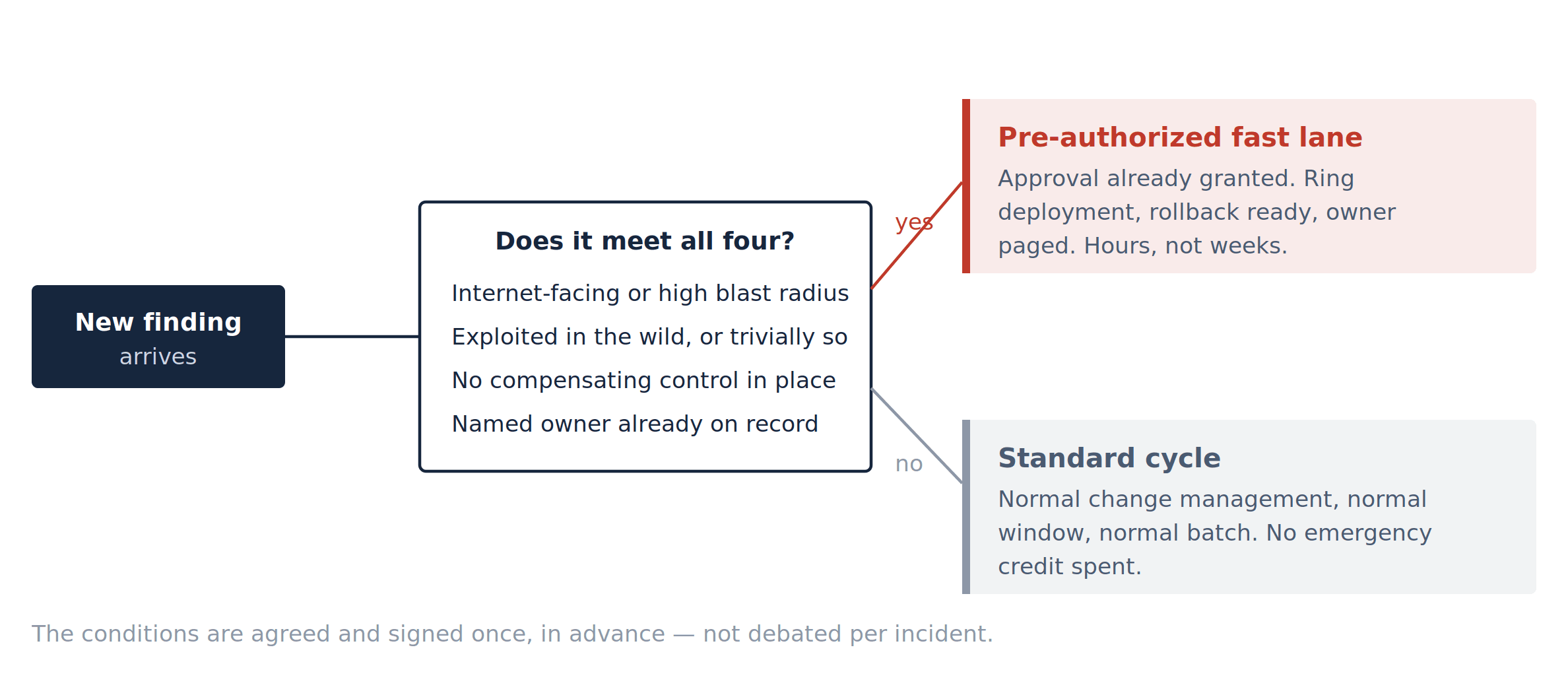
Figure 6. Routing, not ranking. The value comes from making the decision in advance, once, for a class of vulnerability, rather than negotiating it at 11pm with half the stakeholders asleep.
So prioritization stops being a queue ordering and becomes a routing decision. The question is no longer "what do we do first" but "which lane does this go in." Is this a pre-authorized fast-lane change where the approval already happened, or does it join the normal cycle?
The critical word is pre-authorized. Define the conditions now. Internet-facing, known exploited, no compensating control, and the change is pre-approved with a named accountable owner and a documented rollback. Write it down, get it signed, rehearse it.
That is what good prioritization looks like in a compressed-window world. It is a policy that routes, not a spreadsheet that sorts.
How Trinetri closes the gap ?
Everything above describes a capability problem rather than an analytics problem. That is the gap the Trinetri Autonomous Platform is built around: not producing a better-sorted list, but shortening the distance between a vulnerability appearing and it being gone from the estate.
Trinetri runs as one agent, one console, and one data model across three modules - EndpointOps for endpoint management, CloudOps for cloud posture, and MobileOps for mobile devices - with GAS AI, an agentic layer that gathers telemetry, analyzes it, and settles the resulting work autonomously.
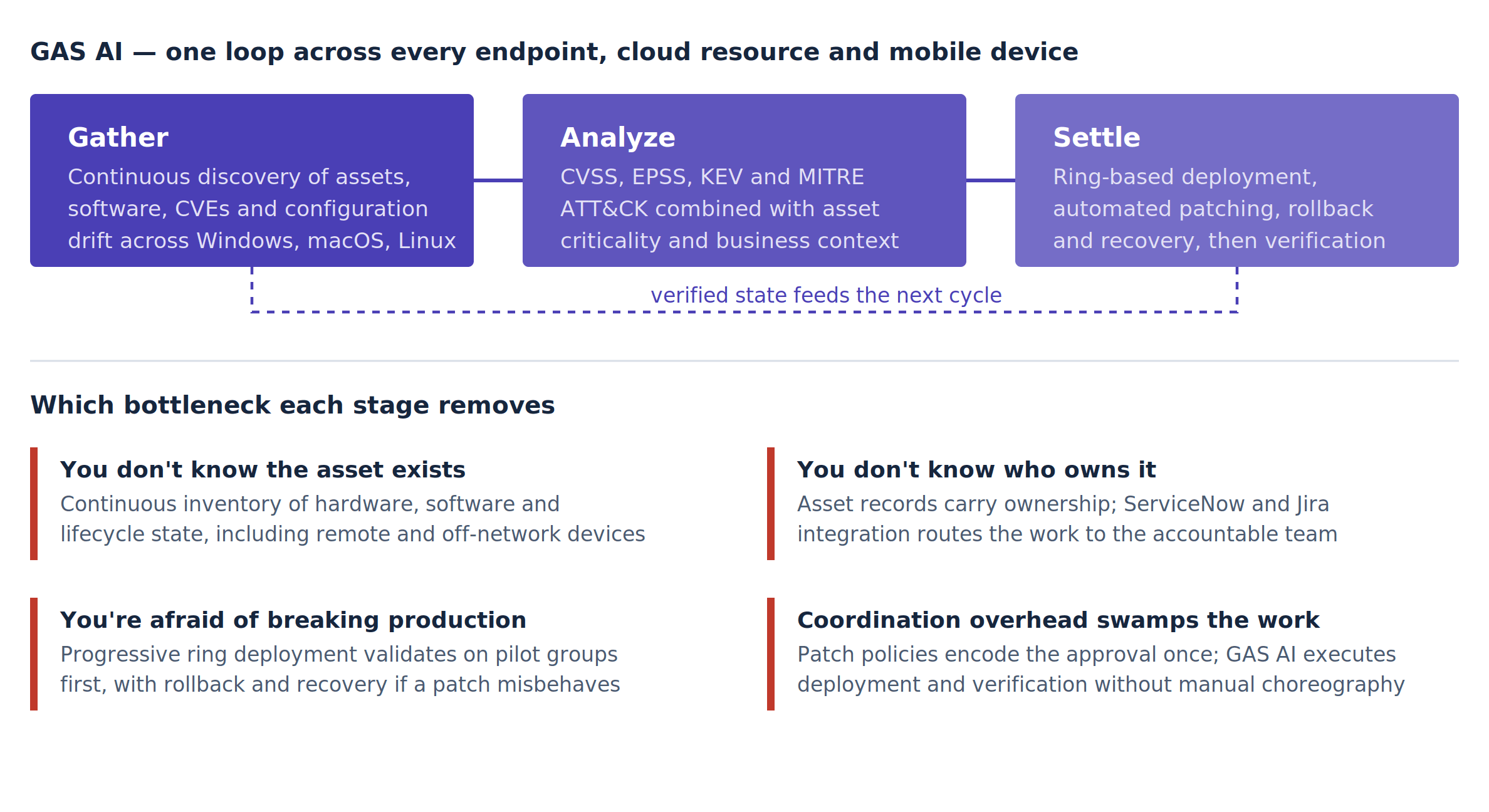
Figure 7. The loop, not the list. Trinetri's design point is that discovery, prioritization and remediation sit on the same agent and the same data model - so the handoffs that consume most of a patch cycle stop existing.
Discovery that keeps up with the estate
The first bottleneck is visibility, and it is the one no scoring engine can help with. EndpointOps continuously discovers assets, installed software, missing patches, unsupported applications and configuration weaknesses across Windows, macOS and Linux, including remote and hybrid devices that spend most of their life off the corporate network. CloudOps extends the same continuous posture assessment into cloud environments, where misconfiguration rather than missing patches is usually the exposure.
The point is not that scanning exists. It is that the inventory and the remediation engine are the same system, so there is no reconciliation step between "the scanner found it" and "the deployment tool can reach it."
Prioritization that routes rather than ranks
Trinetri combines CVE and CVSS severity with EPSS exploit probability, CISA KEV listings, MITRE ATT&CK technique mapping, asset criticality and business context. That is a conventional risk-based stack, and the article's argument is not that this stack is wrong - it is that a stack like this is only worth having if something acts on its output quickly.
That is what changes here. The prioritization feeds directly into patch policies and automated deployment workflows rather than into a report that a human then has to carry across an organizational boundary. Scoring becomes the routing decision described above rather than the final deliverable.
Deployment fast enough to matter, safe enough to authorize
This is where the speed-versus-stability argument gets resolved in practice. Progressive ring-based deployment lets you validate an update on a pilot group before it goes wide, which is what makes pre-authorization defensible to a change board: the fast lane is not "skip the testing," it is "the testing happens automatically in rings, and rollback is one action." Distributed patch delivery keeps bandwidth manageable for branch offices and remote workers. Rollback and recovery mean a bad patch is a reversible event rather than an outage.
Coverage spans operating systems and a large third-party application catalogue, which matters because third-party software is where most of the exploitable surface actually lives, and where most patch programs are weakest.
Autonomy is the velocity mechanism
GAS AI is the part that addresses the coordination tax directly. Rather than a human triaging findings, writing a change ticket, chasing an owner, scheduling a window and confirming completion, the agentic workflow identifies the missing patch, evaluates its risk, recommends or executes the remediation strategy, and verifies the result. The human role moves from executing the loop to setting the policy the loop runs under, and reviewing what it did.
That is the difference between automated and autonomous, and it is also the honest answer to the asymmetry at the end of this article. An attacker with automated tooling needs it to work once. A defender needs it reliable, reversible, and defensible to an auditor. Ring deployment, rollback, policy-based authorization and audit-ready reporting against CIS, PCI DSS, HIPAA and NIST are what let a defender move at attacker speed without accepting attacker-grade reliability.
The number, finally measurable
The question this article opened with - how many hours until it is gone from the fleet - is unanswerable in most organizations because the data lives in four tools that disagree. With discovery, deployment and verification on one platform, patch posture across every endpoint becomes a live figure rather than a reconstruction, which means the velocity ceiling can be measured, reported, and then deliberately improved.
Trinetri is our platform. The argument above stands independently of it, and the questions in this article are worth asking of any vendor, including us.
The asymmetry
The last thing worth sitting with is why this is genuinely hard rather than just neglected.
An attacker using automated tooling needs it to work once. They can tolerate a 90% failure rate because the successful attempt is all that matters. A defender using the same class of tooling needs it to be reliable, tested, safe against production systems, explainable to an auditor, and past change control. The bar is enormously higher on the defensive side, and it should be.
That asymmetry is where the current advantage lives. It will not be closed by buying better analytics. It closes through investment in the boring layer: knowing what you own, knowing who owns it, being able to deploy changes confidently and reverse them quickly, and having rehearsed the emergency path often enough that it is routine rather than heroic.
The teams that will handle the next Log4Shell well are not the ones with the most refined scoring model. They are the ones who can answer, with evidence, how many hours it takes to change something everywhere.
Most teams do not know their number. That is the place to start.