


Fixing Digital Employee Experience, Not Just Measuring It
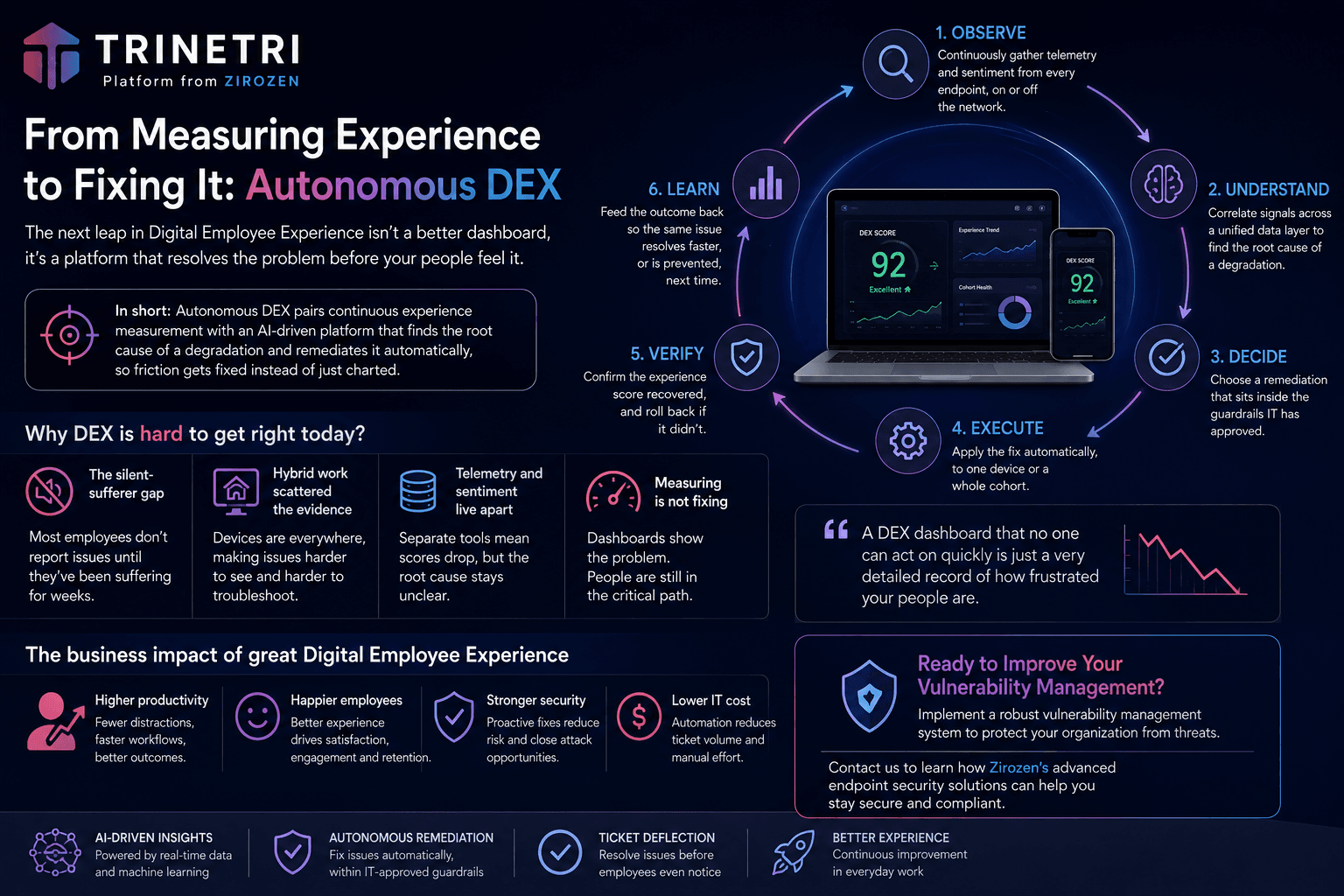
Most DEX tools score the problem and stop there. See how Autonomous Endpoint Management diagnoses and resolves experience issues before the ticket is filed.
From Measuring Experience to Fixing It: Autonomous DEX
Why the next leap in Digital Employee Experience isn't a better dashboard, it's a platform that resolves the problem before your people feel it.
Ask most IT leaders how their employees' technology feels to use, and they can show you a dashboard. Boot times, crash rates, login latency, sentiment scores, all tracked, all trending. What that dashboard usually can't tell you is why the number moved, which employees are quietly suffering, or when any of it will actually be fixed. That gap, between knowing an experience is bad and doing something about it, is where most Digital Employee Experience programs stall.
This is the story of how Autonomous Endpoint Management closes that gap: not by measuring experience harder, but by diagnosing and resolving the issues behind it, often before an employee ever files a ticket.
In short: Autonomous DEX pairs continuous experience measurement with an AI-driven platform that finds the root cause of a degradation and remediates it automatically, so friction gets fixed instead of just charted.
What is Digital Employee Experience (DEX)?
Digital Employee Experience (DEX) is the measured quality of an employee's day-to-day interaction with their technology, their device, apps, network, and login flows. It combines hard telemetry (performance, reliability, stability) with human sentiment to show how work actually feels from the employee's seat.
DEX matters because the cost of bad experience is rarely visible in a single number. A laptop that takes four minutes to become usable each morning, an app that crashes twice a week, a VPN that drops on every call: none of these open a P1 incident, but together they drain productivity, generate low-grade frustration, and quietly push people toward shadow IT and, eventually, toward the door. Experience has become a business metric, not a soft one.
Why is DEX so hard to get right today?
The measurement problem was largely solved. The action problem was not.
The silent-sufferer gap
Most employees don't file tickets for slow, they just live with it, work around it, or blame themselves. By the time a problem is loud enough to reach the service desk, it has usually been degrading the experience of a whole cohort for weeks. Ticket volume is a lagging, lossy signal for how technology actually feels.
Hybrid work scattered the evidence
People now work across home broadband, cellular, and public Wi-Fi, on Windows, macOS, mobile, and everything in between. The device carrying the worst experience is often the one furthest from the corporate network and hardest to see. Any DEX approach that assumes devices "check in" from the LAN inherits a blind spot the day work goes remote.
Telemetry and sentiment live apart
Hard telemetry tells you what is happening: CPU pressure, disk health, boot time, app crashes. Sentiment tells you how it feels. Most organizations collect both but in separate tools, so the score drops and nobody can quickly say which technical condition caused it. Correlation, again, is the missing piece.
Measuring is not fixing
Here's the crux. A DEX score, however sophisticated, is a thermometer. It tells you there's a fever. It doesn't bring the temperature down. In most environments the path from "DEX score dropped for this cohort" to "someone diagnosed it and rolled out a fix" is still entirely manual, which means it's slow, headcount-bound, and reactive. You end up with beautiful dashboards and unchanged experience.
A DEX dashboard that no one can act on quickly is just a very detailed record of how frustrated your people are.
Autonomous Endpoint Management closes the DEX loop
The shift is the same one reshaping endpoint operations generally: stop putting a human in the critical path of every routine fix, and let an AI-driven platform run the loop end to end, under policy the organization sets.
Applied to experience, that loop looks like this:
Observe → Understand → Decide → Execute → Verify → Learn
- Observe: continuously gather both telemetry and sentiment from every endpoint, on or off the network.
- Understand: correlate the signals across a unified data layer to find the root cause of a degradation, not just the symptom.
- Decide: choose a remediation that sits inside the guardrails IT has approved.
- Execute: apply the fix automatically, to one device or a whole cohort.
- Verify: confirm the experience score actually recovered, and roll back if it didn't.
- Learn: feed the outcome back so the same degradation resolves faster, or is prevented, next time.
The last two stages are what turn DEX from reporting into resolution. A tool that flags a slow cohort is monitoring. A platform that flags it, traces it to a bad agent build, rolls the cohort back, confirms scores recovered, and flags the build so it never ships again: that is autonomous experience management.
The engine: Gather, Analyse, Settle
Underneath sits a reasoning engine that runs a full investigative cycle, the same arc a senior engineer would work through, only continuously and across the entire estate:
- Gather: pull every relevant signal, experience scores, device telemetry, app behaviour, recent changes, and prior incidents.
- Analyse: correlate the evidence, isolate the root cause, and weigh the fix against impact, risk, and policy.
- Settle: execute the remediation, verify the experience recovered, document it, and update the model.
What autonomous DEX looks like in practice
Experience issues are ordinary and repetitive, which is exactly why they're a strong fit for autonomy. A few worked examples following the Gather, Analyse, Settle arc:
| Experience issue | Gather | Analyse | Settle |
|---|---|---|---|
| Sluggish-laptop cohort | Experience scores drop for a group; a few users report slow machines | Traces the regression to a recent agent version consuming excess CPU | Rolls the cohort back, confirms scores recover, flags the build for review |
| Slow morning logins | Login and boot times creep up across a site | Correlates to a bloated startup policy and a failing on-boot script | Trims the startup set, repairs the script, verifies boot time drops |
| Recurring app crashes | Crash telemetry spikes for one application on one OS build | Links crashes to an incompatible update on a specific driver version | Stages the driver fix, deploys in-window, confirms crashes stop |
| Battery and thermal complaints | Sentiment dips; devices run hot and drain fast | Finds a background process pinning the CPU after an update | Kills or updates the process, verifies temperature and battery normalize |
| Wi-Fi and VPN friction on calls | Users report drops; connectivity telemetry is noisy | Isolates a driver and power-setting combination on one hardware model | Applies the known-good profile, confirms stability, learns the pattern |
In none of these did IT have to notice the problem, open a ticket, correlate six consoles, and hand-roll a fix. The team set the policy that allowed these actions, and every decision sits in an audit trail they can review. What they were freed from was the routine execution.
Fixing it before the ticket exists
The strategic prize in DEX is ticketless resolution: the degradation is detected, diagnosed, and remediated before the employee is annoyed enough to report it, or before they even notice. That flips the service desk from a queue that absorbs frustration into an exception handler for the rare cases automation can't close. The measure of a mature DEX program isn't how fast you answer experience tickets. It's how many never get filed.
The business case for autonomous DEX
Experience is a business case first and a technology choice second, and the returns land in numbers leaders already watch.
- Higher productivity: pre-emptive fixes remove the daily friction, the slow boots, the crashes, the dropped calls, that quietly taxes every employee's output.
- Fewer tickets, lower support cost: resolving issues before they're reported deflects volume off the service desk and frees skilled staff for higher-value work.
- Better retention and sentiment: technology that "just works" is a real factor in how employees feel about their employer, especially in hybrid and knowledge-work roles.
- Less shadow IT: when the sanctioned setup performs, people stop reaching for unmanaged workarounds that create risk.
- Visibility into the silent majority: continuous, telemetry-plus-sentiment scoring surfaces the cohorts who suffer quietly and would never have shown up in ticket data.
Illustrative planning models suggest that moving from manual to autonomous handling of experience issues can cut the time-to-resolution for those issues substantially and deflect a meaningful share of experience-related tickets before they're filed. Treat these as the shape of the change to validate against your own baseline in a proof of value, not a guarantee.
From dashboards to self-improving experience
DEX has followed the same arc as the rest of endpoint operations. First we couldn't see experience at all. Then dashboards gave us visibility, a genuine step forward, but visibility with manual action attached is capped by how fast a person can correlate data and push a fix. The next step isn't a richer dashboard. It's a platform that acts on what the dashboard sees.
Autonomous Endpoint Management gets there by unifying the data, adding an AI reasoning layer, and closing the loop with governed automation. The dashboard still exists, but it becomes a record of problems the system is already resolving, not a to-do list waiting on a human. And, as with all autonomy, trust is earned in steps: the platform proves itself on low-risk, high-volume experience fixes first, and the scope of what it handles unsupervised widens as confidence builds.
The future of employee experience isn't a team watching scores drop and scrambling to respond. It's a system that keeps the experience good on its own, and tells you what it fixed.
See autonomous DEX in action
Trinetri brings endpoint, cloud, and mobile operations onto one platform, one data layer, one AI, and one console. Its EndpointOps domain scores Digital Employee Experience continuously and, through GAS AI running the Gather → Analyse → Settle loop, diagnoses and resolves degradations across your whole estate, often before your people file a ticket.
→ Explore the Trinetri Autonomous Platform · Book a demo
Publish note: confirm the final landing slug before going live.
/platformis the umbrella target; swap to the EndpointOps page if you'd rather point readers straight to the DEX capability. Wire the internal link up to your UEM / Autonomous Operations pillar with the anchor "autonomous endpoint management," matching the cluster convention.
Frequently asked questions
What is Digital Employee Experience (DEX)?
DEX is the measured quality of an employee's day-to-day interaction with their technology, spanning device, apps, network, and login flows. It blends hard telemetry (performance, reliability, stability) with human sentiment to show how work actually feels from the employee's seat.
How is autonomous DEX different from a traditional DEX tool?
Traditional DEX tools measure and dashboard experience, but resolving what they surface is still manual. Autonomous DEX pairs the same measurement with an AI-driven platform that finds the root cause and remediates it automatically under policy, so friction is fixed rather than just charted.
Can experience issues really be fixed before employees report them?
Often, yes. Because experience degradations are detected in telemetry before they cross a user's annoyance threshold, the platform can diagnose and remediate many of them pre-emptively. This "ticketless resolution" is the strategic goal: the service desk handles exceptions, not routine friction.
Does autonomous DEX replace the service desk?
No. It removes routine, repetitive experience fixes from the queue so the desk becomes an exception handler for cases automation can't close. Staff shift from reactive triage to governing the system, reviewing exceptions, and improving policy.
What causes most DEX problems?
Commonly: resource pressure (CPU, memory, disk), bad or incompatible updates and drivers, bloated startup and configuration policies, failing background processes, and network or VPN issues, many of which are worse on remote devices that rarely touch the corporate network.
How do you measure the ROI of improving DEX?
Watch time-to-resolution for experience issues, the share of issues resolved before a ticket is filed (deflection rate), service-desk volume, and productivity and sentiment trends. Validate any vendor figures against your own baseline in a proof of value.
This post draws on themes from the Trinetri whitepaper "Beyond UEM: The Rise of Autonomous Endpoint Operations." Figures described as illustrative are directional planning models for validation against your own baseline, not measured customer outcomes.