


Cloud Security Posture Management (CSPM): Why Misconfiguration Is the #1 Breach Vector
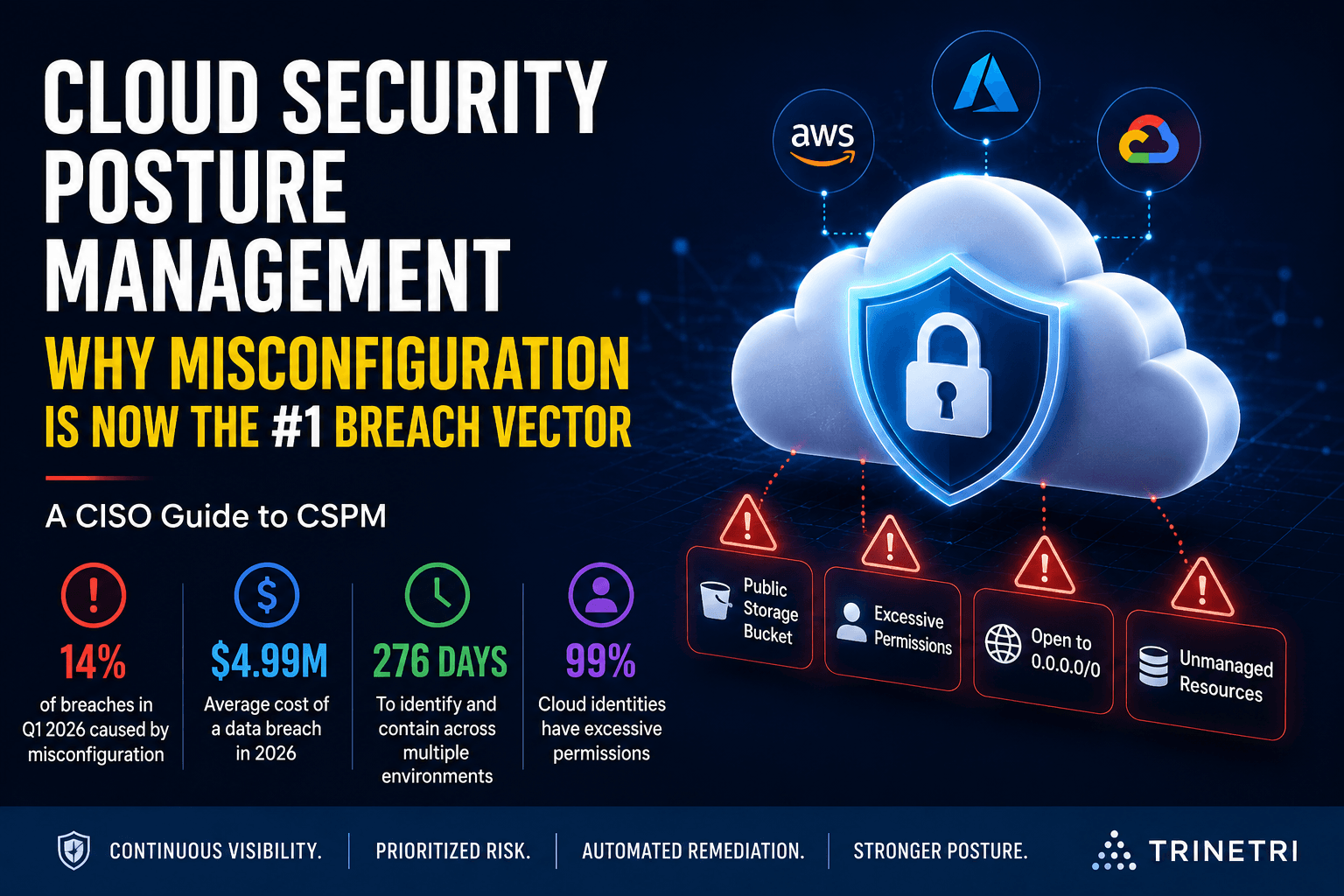
Cloud misconfiguration now drives 14% of global breaches and record breach costs. A CISO guide to CSPM, covering why posture drifts, why quarterly audits fail, and how to evaluate a platform.
Cloud Security Posture Management: Why Misconfiguration Is Now the #1 Breach Vector
Key takeaways
- Cloud misconfiguration is now the largest single technical breach vector, responsible for 14% of global breaches in Q1 2026, up from 9% in 2024 (Verizon DBIR 2026).
- The global average cost of a data breach reached USD 4.99 million in 2026, a 12% rise on the previous year and a record high (IBM Cost of a Data Breach 2026).
- Breaches spanning multiple environments take 276 days to identify and contain, 59 days longer than incidents confined to on premises infrastructure.
- 99% of cloud identities hold excessive permissions across 680,000 analysed by Palo Alto Unit 42, making identity, not storage buckets, the larger misconfiguration risk.
- Quarterly posture assessment leaves an average 45 day exposure window per misconfiguration. Automated scanners find exposed resources in hours.
- Mean time to remediate critical misconfigurations is the metric that matters, not total finding count.
- Organisations using AI and automation extensively in security saved an average of USD 1.93 million per breach.
Most cloud breaches do not begin with an exploit. They begin with a checkbox.
A storage bucket set to public during a migration and never set back. A security group opened to 0.0.0.0/0 for a debugging session on a Friday afternoon. A service account granted broad permissions for a data project that lasted a week and finished eleven months ago. A snapshot copied to a second region that nobody remembers creating, in an account nobody has looked at since the team that owned it was reorganised.
None of these are attacks. Every one of them is a door left open by the organisation itself, and when an attacker walks through it, the incident report reads the same as if they had broken in.
For security leaders, this is an uncomfortable category of risk. It is not a zero day you could not have anticipated. It is not an APT with nation state funding. It is a configuration setting that was wrong, and that stayed wrong long enough for someone to find it. Boards understand that framing immediately, and it is a difficult conversation to have after the fact.
What Is Cloud Security Posture Management?
Cloud Security Posture Management (CSPM) is the continuous automated assessment of cloud infrastructure configuration against security best practices and compliance frameworks, identifying misconfigurations, excessive permissions and risky exposure across AWS, Azure and Google Cloud before attackers exploit them. CSPM covers four core functions: continuous asset discovery and inventory, misconfiguration detection against benchmarks such as CIS, prioritisation based on real risk, and guided or automated remediation.
The distinction that matters is between configuration and behaviour. CSPM operates on the cloud control plane, the settings that determine what exists, who can reach it, and what they can do with it. It answers a question no runtime tool can: is this environment built correctly in the first place?
Four capabilities define a credible platform:
- Continuous discovery and inventory across every account, region and provider, normalised into one schema, so an Amazon S3 bucket, an Azure storage account and a Google Cloud Storage bucket become comparable objects rather than three separate vocabularies.
- Misconfiguration detection against benchmarks such as the CIS Foundations, spanning storage, identity, network and compute.
- Prioritisation informed by context. An excessively permissioned role attached to a publicly reachable resource holding regulated data is not the same finding as the identical role in an isolated sandbox, even though a rules engine scores them the same.
- Remediation that is guided, produces evidence ready for audit, and runs automatically for well understood violation classes.
How Much Does a Cloud Misconfiguration Breach Cost in 2026?
The global average cost of a data breach is USD 4.99 million, a 12% increase on the previous year and a record high, according to the IBM and Ponemon Institute Cost of a Data Breach Report 2026. The rise was driven principally by higher detection, escalation and lost business costs, precisely the lines that inflate when an exposure sits unnoticed.
That figure reverses the previous year's decline, and the direction of travel matters more than the absolute number.
Cloud estates carry a measurable premium. The prior year's research found breaches involving data spread across multiple environments averaged USD 5.05 million, the highest of any configuration, and took 276 days to identify and contain, 59 days longer than incidents confined to on premises infrastructure. Complexity has a price, and it is paid in dwell time.
Two further data points sharpen the picture. Attacks driven by AI rose 56%, led by deepfake impersonation and AI enabled malware, compressing the interval between an exposure appearing and being found. On the other side of the ledger, organisations making extensive use of AI and automation in security saved an average of USD 1.93 million compared with those using none.
Read together, the conclusion is uncomfortable but clear: attackers have automated discovery, and defenders who have not automated detection and remediation are losing on tempo, not on budget.
What Percentage of Cloud Breaches Are Caused by Misconfiguration?
Cloud misconfiguration accounts for 14% of all global breaches in Q1 2026, up from 9% in 2024, making it the single largest technical breach vector according to analysis of the Verizon Data Breach Investigations Report 2026. The longstanding Gartner projection, that 99% of cloud security failures through 2026 would be attributable to the customer rather than the provider, primarily through misconfiguration, has aged well.
The identity dimension is larger still, and more often overlooked. Unit 42 at Palo Alto Networks analysed 680,000 cloud identities and found 99% of users, roles and service accounts held excessive permissions. Google Cloud CISO Perspectives attributes 70% of cloud breaches to compromised identities. Storage buckets get the headlines. Excessively permissioned roles do the damage.
The environment also keeps getting harder to hold still. 88% of organisations now run hybrid or multicloud estates, and 69% report they cannot maintain uniform security controls across cloud service providers. Every additional provider adds a different permission model, a different set of defaults, a different logging format, and a fresh surface for policy drift.
Why Do Cloud Misconfigurations Keep Happening?
Misconfigurations persist because provisioning speed has outrun review speed, not because engineers are careless. Filing this under human error and prescribing more training is a misdiagnosis, and the remediation that follows from it does not work.
Five structural causes:
Provisioning velocity outruns review velocity. A single terraform apply can create hundreds of resources in ninety seconds. Your change advisory board meets on Tuesdays. The gap between those clock speeds is where posture drift lives, and no amount of process discipline closes a gap of that magnitude.
Infrastructure as code industrialises mistakes. It is a genuine security advance, until a module with a permissive default gets forked across forty repositories. Then one flawed decision replicates at machine scale, and remediating it means finding every copy.
Defaults are optimised for adoption, not for you. Cloud providers make it easy to get something running. The secure configuration is frequently the more effortful one, and effort loses to deadline pressure with predictable regularity.
Ownership is genuinely ambiguous. Platform engineering provisions, application teams deploy, and security is accountable for outcomes it does not control. When nobody unambiguously owns configuration state, gaps fall into the space between teams and stay there.
Nobody has a reliable inventory. This is the foundational failure, because every downstream control assumes you know what you are running. In practice, estates accumulate abandoned development accounts from acquisitions, regions enabled for a proof of concept, and resources created by CI pipelines nobody maintains. The average enterprise is estimated to be running over 3,000 misconfigured cloud assets at any given moment. You cannot secure what you cannot enumerate.
Why Periodic Cloud Security Assessments Fail
Quarterly assessment leaves an average exposure window of roughly 45 days per misconfiguration, while automated scanners discover publicly exposed resources within hours. That arithmetic is the whole problem. You are sampling a fast moving system at a frequency several orders of magnitude too slow, and calling the result assurance.
Most organisations already do posture assessment. They do it quarterly, or annually, or eight weeks before the SOC 2 audit, usually via consultants with a spreadsheet. The 45 day figure also assumes the fix is immediate, which it is not.
The compliance version of this failure is more insidious. Teams remediate to pass the audit, the certificate is issued, and configuration drifts back over the following months, often within weeks, as exceptions granted for the audit window quietly become permanent. The organisation holds a valid attestation and an invalid posture simultaneously. Auditors are satisfied. Attackers are unaffected.
The metric that actually matters is mean time to remediate a critical misconfiguration, measured from the moment it appears rather than the moment you happened to discover it. Most organisations cannot calculate this number, because they have no reliable record of when the exposure began.
CSPM vs CWPP vs CIEM vs CNAPP: What Is the Difference?
CSPM secures cloud configuration, CWPP secures running workloads, CIEM secures identities and entitlements, and CNAPP is an umbrella category bundling some combination of the three. CSPM is the foundation layer, because configuration determines what the other tools are defending.
| Category | Answers | Scope | Deployment | Best for |
|---|---|---|---|---|
| CSPM | Is my cloud configured securely? | Control plane configuration: storage, IAM, network, compute | Agentless, via provider APIs | Preventing misconfiguration breaches, continuous compliance |
| CWPP | Is what runs inside my workloads secure? | Virtual machines, containers, serverless runtime | Agent or sidecar | Runtime threat detection, workload hardening |
| CIEM | Who and what can act in my cloud, and should they? | Identities, roles, entitlements, permission paths | Agentless, via provider APIs | Enforcing least privilege, resizing permissions |
| CNAPP | Umbrella spanning the above | Varies substantially by vendor | Mixed | Consolidating multiple point tools |
A practical warning on CNAPP: actual coverage differs enormously between vendors wearing the same label. Verify each component individually rather than accepting the acronym. Many CNAPP offerings are a strong CSPM with thin workload protection bolted on, or the reverse.
CSPM also carries the best ratio of risk reduced to effort expended, because it addresses the vector causing the most breaches and the one most preventable.
How to Evaluate a CSPM Vendor: 7 Questions to Ask
These seven questions separate substance from demo polish.
1. How is the inventory built, and how fast does it reflect reality? Agentless discovery through provider APIs across all connected accounts and regions, refreshed on a defined sync interval, is the baseline. Ask what happens when a new account is created. Is it discovered automatically, or does someone have to remember to onboard it?
2. How does prioritisation work? If the answer is a static severity label from a benchmark, you will receive thousands of findings and no signal. You need scoring that accounts for exposure path, data sensitivity and blast radius. The realistic goal is a triaged list of dozens, not an inbox of thousands.
3. Can it remediate, or only report? Reporting tools generate work. Remediation tools reduce it. Ask specifically which violation classes can be fixed automatically, what approval gates exist, and what rollback looks like when a fix breaks something.
4. How are compliance frameworks handled? Continuous control evaluation with automated evidence collection mapped to CIS, SOC 2, ISO 27001, PCI DSS and HIPAA is the standard, not a PDF export you assemble manually before the audit.
5. Does it integrate with how work actually gets done? Findings that do not become tickets in the systems engineers already use will not get fixed. Jira, ServiceNow, Slack and Teams integration is not optional.
6. Is posture connected to cost? The same inventory revealing an unencrypted volume also reveals it has been idle for six months. Orphaned resources draining budget and orphaned resources creating risk are frequently the same resources.
7. How much of your existing stack does it consolidate? Tool sprawl is itself a security problem. Four consoles means four sets of blind spots at the seams, and four teams each assuming another owns the gap.
Which Cloud Security Metrics Should CISOs Report to the Board?
Report exposure duration and trend, not finding counts. A board cannot interpret "4,200 open findings," but it can interpret "critical misconfigurations are now fixed in 6 hours, down from 11 days."
| Metric | Why it matters |
|---|---|
| Mean time to remediate critical misconfigurations | The single best proxy for real exposure |
| Posture score trend by business unit | Makes ownership visible and comparable |
| Percentage of estate under continuous assessment | Coverage gaps are where breaches originate |
| Mean age of open critical findings | Catches the backlog that averages conceal |
| Compliance drift events between audits | Distinguishes real control health from paper compliance |
| Percentage of findings remediated automatically | Measures whether you are scaling or just hiring |
How to Implement CSPM: A 90 Day Plan
CSPM deployment follows three phases: establish inventory and baseline in month one, prioritise exploitable exposures and automate frequent fixes in month two, then push guardrails into deployment pipelines and enable continuous compliance reporting in month three. Agentless platforms typically complete initial connection and baseline inventory within days.
Days 1 to 30. Establish ground truth. Connect every cloud account, including the forgotten ones. Build a normalised inventory. Baseline against CIS. Expect the initial finding count to be alarming. It is a measurement, not a verdict.
Days 31 to 60. Prioritise and prove the loop. Filter to genuinely exploitable exposures: public reachability, excessively permissioned identities, unencrypted regulated data, absent logging. Pick two or three violation classes that recur frequently and automate their remediation end to end. Establish your remediation time baseline.
Days 61 to 90. Make it durable. Push guardrails earlier into the deployment pipeline so the same misconfiguration cannot recur. Map controls to your compliance frameworks and enable automated evidence collection. Assign named owners per account or business unit. Begin reporting the trend, not the total.
Trinetri CloudOps: Unified CSPM, Compliance and Cost Management
Trinetri CloudOps is a unified cloud operations platform combining multicloud asset inventory, security posture management, compliance assessment and cost management on a single control plane across AWS, Azure and Google Cloud, with GAS AI automating analysis and remediation.
It was built around a specific observation. Security posture, asset inventory, compliance evidence and cloud cost are four views of one dataset, and splitting them across four tools creates exactly the seams that misconfigurations hide in.
Cloud inventory. Automated discovery of compute, storage, network, identity and managed services across every connected account and region, normalised into one consistent, searchable schema that refreshes on every sync. Query the full estate in natural language or SQL.
Security posture. Misconfiguration detection across storage, identity, network and compute. Risk scoring that uses context to surface the exposures most likely to be exploited. Posture scores per account and team that can be tracked over time. Guided remediation that produces evidence ready for audit, with automation for common policy violations.
Continuous compliance. Coverage out of the box for CIS, SOC 2, ISO 27001, PCI DSS and HIPAA plus custom policies, evaluated on every sync, with automatic evidence collection mapped to the relevant controls and reporting formatted for each framework.
Cost management. Spend broken down by account, service, team and tag, with detection of idle and oversized resources, rightsizing recommendations that quantify the savings, plus budgets and forecasts.
Underpinning all four, GAS AI (Gather, Analyse, Settle) operates as a continuous cloud operations engineer, security analyst and FinOps specialist. It answers plain language questions about your estate, moves from finding to root cause with full context, detects anomalies in posture, configuration and spend, and executes approved remediation workflows autonomously.
Organisations running CloudOps report complete normalised asset visibility across every cloud account and region, 70% faster remediation of misconfigurations and policy violations, 99% continuous compliance coverage, and 30% lower cloud spend through continuous optimisation.
Because CloudOps shares one agent, one data model, one console and one AI layer with Trinetri EndpointOps and MobileOps, problems crossing the boundary between cloud and endpoint stop disappearing into the gap between two vendor dashboards.
Frequently Asked Questions
What is cloud security posture management?
Cloud Security Posture Management is the continuous automated assessment of cloud configuration against security best practices and compliance frameworks. CSPM detects misconfigurations, excessive permissions and risky exposure across AWS, Azure and Google Cloud, then prioritises and remediates them before they become incidents.
What percentage of breaches are caused by cloud misconfiguration?
The Verizon DBIR 2026 identifies cloud misconfiguration as the largest technical breach vector, responsible for 14% of global breaches in Q1 2026, up from 9% in 2024. Gartner projected that 99% of cloud security failures through 2026 would be attributable to the customer rather than the cloud provider.
How much does a cloud data breach cost?
The IBM Cost of a Data Breach Report 2026 puts the global average at USD 4.99 million, a 12% increase on the previous year and a record high. Breaches spanning multiple environments are costliest, averaging USD 5.05 million and taking 276 days to identify and contain.
What is the difference between CSPM and CNAPP?
CSPM assesses cloud configuration at the control plane, covering storage, identity, network and compute settings. CNAPP is a broader umbrella that typically bundles CSPM with workload protection, identity entitlement management and code scanning. Actual CNAPP coverage varies substantially between vendors, so verify each component individually.
How often should cloud security posture be assessed?
Continuously. Quarterly assessment leaves an average exposure window of roughly 45 days per misconfiguration, while automated scanners discover publicly exposed resources within hours. Modern CSPM platforms evaluate configuration on every synchronisation cycle rather than on an audit calendar.
Which compliance frameworks does CSPM support?
Mature CSPM platforms provide continuous assessment against CIS Benchmarks, SOC 2, ISO 27001, PCI DSS and HIPAA, plus custom organisational policies. The differentiator is automated evidence collection mapped to specific controls, which removes manual evidence gathering before audits.
Does CSPM work across AWS, Azure and Google Cloud?
Yes. Multicloud CSPM discovers resources across all connected accounts and regions, then normalises them into a single schema so equivalent resources become directly comparable. This matters because 88% of organisations now run hybrid or multicloud estates and 69% report they cannot maintain uniform controls across providers.
How long does CSPM implementation take?
Initial connection and baseline inventory typically complete within days for agentless platforms built on provider APIs. A realistic 90 day sequence establishes inventory and baseline in month one, prioritises exploitable exposures and automates frequent fixes in month two, then pushes guardrails into deployment pipelines and enables continuous compliance reporting in month three.
The uncomfortable question
If a researcher scanned your cloud estate tomorrow morning, what would they find, and how long would it have been there?
Most security leaders cannot answer the second half of that question with confidence. That gap, not a shortage of budget or talent, is what the breach statistics are actually measuring.
Explore CloudOps to cloud posture, compliance and spend on one screen.