


Beyond UEM: The Rise of Autonomous Endpoint Operations
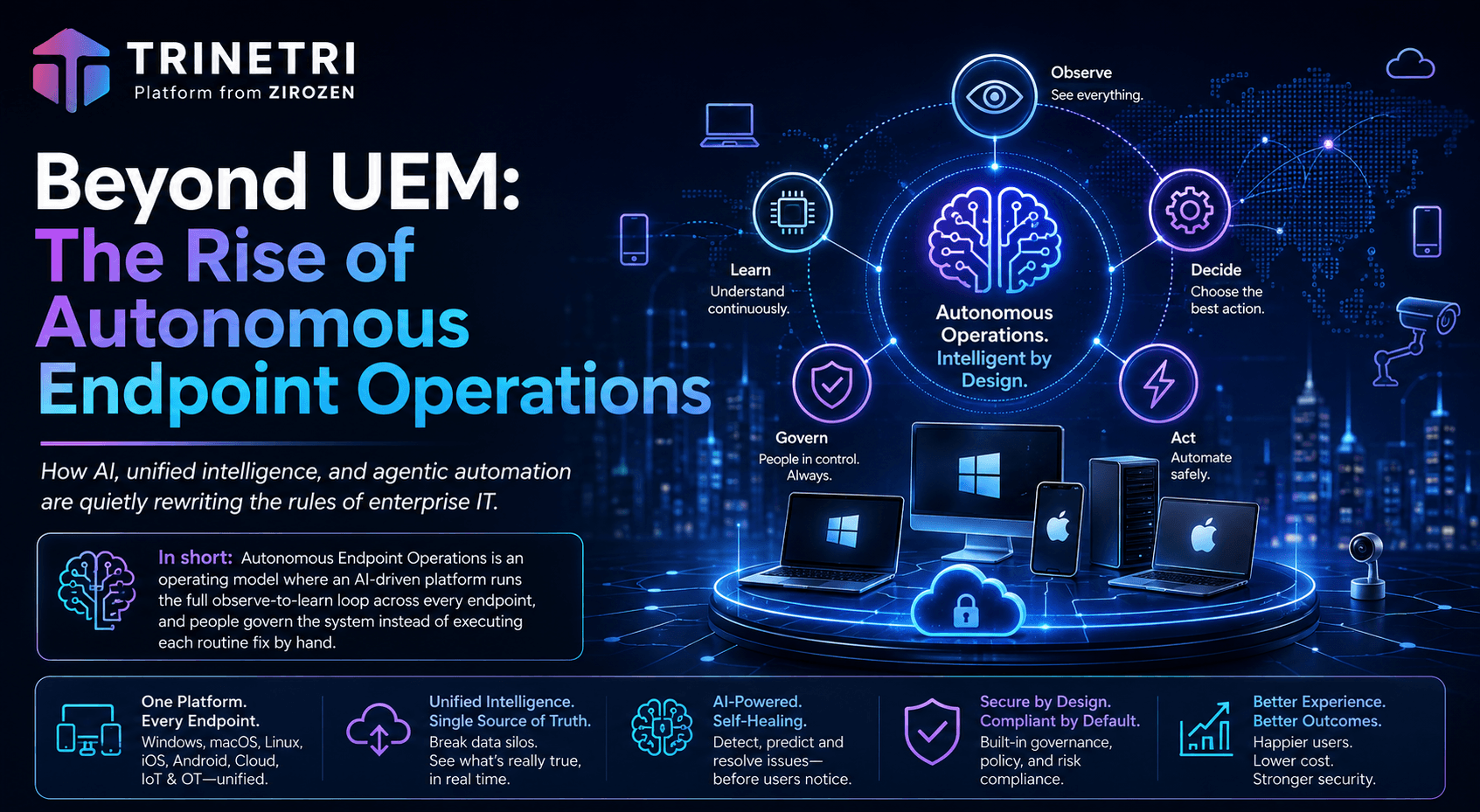
UEM unified the console, not the intelligence. See how Autonomous Endpoint Operations closes the loop with AI, unified data, and governed automation.
Beyond UEM: The Rise of Autonomous Endpoint Operations
How AI, unified intelligence, and agentic automation are quietly rewriting the rules of enterprise IT.
For thirty years, the answer to a harder IT problem was always the same: buy another tool. Another console, another agent, another database. It worked, until it didn't. Today the endpoint estate has grown so large, so varied, and so fast-moving that the real bottleneck is no longer technology at all. It's the human sitting in the middle of every loop.
This is the story of how endpoint management is moving past that ceiling, from unified management to autonomous operations.
In short: Autonomous Endpoint Operations is an operating model where an AI-driven platform runs the full observe-to-learn loop across every endpoint, and people govern the system instead of executing each routine fix by hand.
The endpoint estate outgrew the tools built to manage it
A whole generation of management tools was built on one assumption: that an "endpoint" was a company-owned Windows PC, sitting on the corporate network, patched once a month, imaged from a golden template. Every part of that assumption has since fallen apart.
Today's estate is mixed by default and spread out by design:
- Windows, macOS, and Linux workstations, each with its own patch cadence, configuration model, and management API.
- iOS and Android devices that are now primary productivity tools, arriving under a tangle of corporate-owned and bring-your-own arrangements.
- Cloud workloads on AWS, Azure, and Google Cloud that behave like endpoints in every way that matters, except they can appear and vanish within minutes.
- IoT and operational-technology hardware such as sensors, cameras, point-of-sale terminals, and medical or industrial equipment, which tends to be unmanaged, rarely patched, and invisible to the tools watching over laptops.
And the people using all of it are scattered, mobile, and almost never offline. Industry projections put the connected-endpoint count in the tens of billions and climbing, with figures around 55.7 billion connected endpoints worldwide.
Meanwhile, the way work happens changed just as sharply as the hardware. Roughly 83% of organizations now run a hybrid or fully remote model. The devices carrying corporate data spend much of their lives off the corporate network entirely, connecting over home broadband, cellular, and public Wi-Fi. A laptop that never touches the VPN can go months without a policy update, a patch, or a compliance check, which makes the remote endpoint both more exposed and harder to see. About the worst combination you could ask for.
Here's the uncomfortable part: in plenty of enterprises, nobody actually knows the true endpoint count. The gap between what the asset database says and what's really connected (shadow devices, unenrolled BYOD, forgotten cloud instances) can differ by tens of percent. That gap is one of the biggest sources of unmanaged risk on its own.
Why is traditional UEM no longer enough?
Unified Endpoint Management earned its place. Pulling PC lifecycle management and mobile device management onto one policy plane was a genuine improvement over the days of separate, siloed products. But UEM was designed to solve a configuration problem, namely how to push consistent policy out to a lot of devices, back when the estate was smaller, more uniform, and mostly on the network.
The trouble is that UEM unified the console, not the intelligence behind it. The data stayed scattered, and the work stayed manual.
Multiple consoles, multiple databases
Hardly any enterprise runs just "a UEM." They run a UEM plus a separate vulnerability scanner, a patch tool, a configuration-management system, a mobile product for the awkward cases, a cloud-posture tool, and a digital-experience monitor, each bought to close a specific gap. Every one keeps its own datastore, its own device identifiers, and its own partial view of the truth.
Ask a simple question, such as "what's actually true about this device right now?", and there's no single answer, because the truth is spread across a dozen databases that don't agree with each other.
Fragmented visibility is the real failure
When the vulnerability scanner, the patch system, and the compliance tool each carry a different device list, a critical exposure can sit unnoticed in the seam between them for as long as it likes. Analysts keep finding that most successful attacks exploit conditions the organization could already see in some tool. The failure is one of correlation, not detection. Seeing everything in pieces is, in practice, not far from seeing nothing at all.
The compounding cost of tool sprawl
| Symptom | Operational consequence | Downstream cost |
|---|---|---|
| Duplicate agents | Each tool ships its own endpoint agent | Device performance drag, more complaints |
| Reconciliation work | Engineers manually match records across tools | Hours per incident lost to correlation |
| Reactive posture | Action only after an alert fires | Longer dwell time, higher breach cost |
| License overlap | Redundant coverage across products | Inflated total cost of ownership |
| Tribal knowledge | Fixes live in individual engineers' heads | Key-person risk, slow onboarding |
Reactive by design, automated in name only
Traditional UEM is reactive at its core. It reports state and then waits for a person to spot something wrong, form a theory, pull evidence from a handful of consoles, decide on a fix, and apply it. That monitor → alert → investigate → remediate → report loop puts a skilled engineer in the critical path of every single incident.
And most tools that call themselves "automated" really offer scripted tasks: run this package, apply this baseline, kicked off and watched over by a person. That's task automation, not operational autonomy. A human still decides what runs, where, and when, then judges whether it actually worked.
Unifying the console was the opening act. Unifying the data, and putting real intelligence on top of it, is the part that actually changes the economics.
What is Autonomous Endpoint Operations?
Autonomous Endpoint Operations is an operating model in which an AI-driven platform runs the routine endpoint loop, observe, understand, decide, execute, verify, and learn, from end to end across the whole estate, while people set policy, guardrails, and strategy instead of performing each fix by hand.
Every engineering discipline that matures eventually moves people up the stack, from doing the work, to overseeing it, to setting the policy the work follows. Manufacturing went through it with process automation. Networking got there with intent-based systems. Software delivery did it with CI/CD and self-healing infrastructure. Endpoint operations has now reached the same turning point.
This isn't "UEM with an AI assistant bolted on." Its center of gravity is somewhere else entirely. In UEM, the console is the product and the human is the engine. Here, the closed loop is the product, AI is the engine, and the human's job is to supervise and write policy.
What defines the category is a six-stage loop that runs continuously across the whole estate:
Observe → Understand → Decide → Execute → Verify → Learn
- Observe: continuous telemetry from every endpoint.
- Understand: AI correlation across a unified data layer.
- Decide: root cause and a policy-bound course of action.
- Execute: automated remediation within guardrails.
- Verify: confirm the outcome, roll back if it didn't hold.
- Learn: feed outcomes back to improve future decisions.
The last two stages, Verify and Learn, are what separate autonomy from automation. A script that applies a patch is automation. A system that applies the patch, confirms the vulnerability is closed and the device is healthy, rolls itself back if the device regresses, and adjusts how much it trusts that remediation next time, that's autonomy.
People are still essential, but the job changes. They set the guardrails, sign off on which kinds of action the system can take unsupervised, review the exceptions, and steer strategy. The routine work drops off their queue.
Autonomy is earned, not switched on
No organization gets to full autonomy overnight, and none should try. Autonomy is trust that has to be earned: the system proves itself on low-risk, high-volume work first, and the range of things it's allowed to do unsupervised widens as confidence builds.
A simple maturity model gives leaders a shared vocabulary:
- L0 (Manual): Fragmented tools, human-driven everything. Reactive and tribal.
- L1 (Unified): Single console and data layer. Visibility consolidated; action still manual.
- L2 (Assisted): AI correlates and recommends; humans approve and execute. The copilot era.
- L3 (Supervised Autonomy): The system executes routine remediations within guardrails; humans supervise exceptions.
- L4 (Autonomous): Self-healing across the estate; humans set policy and strategy, and review outcomes.
Most enterprises today sit somewhere between L0 and L1, with a bit of L2 showing up as copilots arrive. The real question for leaders isn't whether to adopt AI, it's how deliberately to climb this curve, and whether their platform's architecture can actually carry them past L2. That ceiling comes down almost entirely to whether the underlying data and automation are unified. You can't automate a loop you can't see from end to end.
What makes it real: unified data, an AI engine, and governed automation
Autonomy is an architectural property long before it's a feature. Platforms that stall short of autonomy do so because their tools fragment the very data and control that autonomy needs. So a platform that can genuinely deliver Autonomous Endpoint Operations has to be unified at the foundation, not just integrated at the surface.
That comes down to four commitments:
- One Platform: endpoint, cloud, and mobile operations in a single system, not a suite of acquired products stitched together.
- One Data Layer: every signal normalized into one model, so each device has exactly one authoritative record.
- One AI: a single reasoning engine with visibility across the entire estate rather than one domain.
- One Console: one place to observe, converse, and govern, with no context-switching across tools.
Because each asset has a single authoritative record, correlation becomes a query instead of a reconciliation project. Cross-domain questions like "which cloud workloads and laptops share this vulnerable library?" finally have an answer.
Meet the reasoning engine: Gather, Analyse, Settle
Most "AI" in operations tools today is a search box or a summarizer, useful, but stuck at the assist tier. A purpose-built autonomous engine runs a full investigative cycle instead, the same arc a senior engineer works through, only continuously and across the whole estate:
- Gather: pull every relevant signal, telemetry, inventory, vulnerability state, configuration, logs, and prior incidents, then assemble complete context.
- Analyse: correlate the evidence, detect anomalies, determine root cause, and reason about options, weighing impact, risk, and the policy guardrails that bound acceptable action.
- Settle: execute the chosen remediation, verify the outcome, roll back on regression, document the resolution, and update the model so the next occurrence resolves faster.
Here's what that looks like in practice:
| Scenario | Gather | Analyse | Settle |
|---|---|---|---|
| Patch failures at scale | 2,300 endpoints report a failed cumulative update | Correlates failures to one disk-space precondition on a single hardware model | Frees space, re-runs the patch, verifies success, reports the pattern |
| Vulnerability investigation | A critical CVE drops for a widely deployed library | Identifies affected assets, ranks by exposure and exploitability | Patches internet-facing assets first, isolates the unpatchable, tracks to closure |
| Device slowdown | Experience scores drop for a cohort; users report sluggish laptops | Traces the regression to a recent agent version consuming excess CPU | Rolls the cohort back, confirms scores recover, flags the build for review |
| Compliance & drift | Scans surface an unmanaged agent, a cert expiring in 7 days, drifted baselines | Maps each finding to the control it violates and the owner responsible | Reapplies baseline, renews the cert, quarantines shadow IT, evidences the fix for audit |
In none of these cases did the human actually leave the loop. They set the policy that allowed these actions in the first place, and they can review every decision in the audit trail. What they were freed from was the routine execution. That's what autonomy means in practice: the team's attention shifts from performing thousands of small fixes to governing the system that performs them.
Twelve places autonomy proves itself
Autonomy earns its keep in the ordinary, day-to-day stuff, not the dramatic edge cases. A mature autonomous platform quietly handles:
- Zero-touch provisioning: a new device enrolls itself, receives its role-based config, apps, certs, and baselines, and reports ready. No imaging, no technician touch.
- Patch automation: first- and third-party patches tested, staged by ring, deployed in-window, verified, and retried on failure.
- AI root-cause analysis: telemetry correlated across the estate to pinpoint the single condition behind a wave of symptoms.
- Continuous compliance auditing: controls evaluated continuously; drift corrected and evidenced automatically, turning audits from events into a live state.
- Vulnerability prioritization: exposures ranked by real risk, reachability, and asset criticality, not raw CVSS.
- Software lifecycle management: software deployed, updated, reclaimed when unused, and retired at end-of-life automatically.
- Shadow IT detection: unmanaged apps, devices, and cloud instances discovered, mapped to owners, and brought under governance.
- DEX optimization: digital experience scored continuously; degradations often resolved before the user files a ticket.
- Predictive failure detection: early signals predict hardware failures so devices are swapped before an outage.
- Certificate monitoring: the cert estate tracked end to end; expiries predicted and renewals executed before a trust failure.
- Configuration drift management: deviations from approved baselines detected and remediated to a known-good state.
- Automated incident resolution: recurring incidents resolved end to end without ever entering a human queue.
The real measure of an autonomous platform isn't what it can do when you ask, it's how much of the day never needs you to ask at all.
The business case comes first
Autonomy is a business case first and a technology choice second. The returns land in the numbers executives already watch: how fast things get resolved, what operations cost, how much risk the business carries, and how productive the workforce is.
The strategic shift is this: autonomy decouples operational cost from estate scale. When resolution depends on engineer headcount, cost rises right alongside the estate. When routine resolution is autonomous, cost stops tracking scale and people's effort goes into judgment instead.
The benefits that follow:
- Reduced MTTR: autonomous diagnosis and remediation collapse the correlate-and-decide phase that dominates resolution time.
- Lower operational cost: routine work leaves the human queue, and consolidation removes overlapping licenses and agents.
- Higher endpoint visibility: one data layer eliminates the seams where unmanaged and misreported assets hide.
- Improved compliance: continuous, evidenced control replaces point-in-time audits and manual remediation.
- Better employee productivity: often pre-emptive fixes reduce downtime and friction for the workforce.
- Reduced security exposure: faster patching and drift correction shrink the exploitable window and dwell time.
Illustrative planning models for organizations climbing from Manual (L0) toward Autonomous (L4) point to reductions of up to ~65% in mean time to resolution, up to ~70% in manual remediation effort, patch and compliance coverage toward ~99%, and up to ~50% tool and license consolidation. Treat these as the shape of the change to validate against your own baseline, not a promise. Notably, breach-cost research consistently links heavy use of security automation and faster containment to meaningfully lower breach costs, one of the few areas where the financial payoff of automation shows up directly in third-party data.
Where this is heading
Autonomous Endpoint Operations is an early example of a bigger movement toward the agentic, self-healing enterprise. The same combination of mature AI reasoning, unified operational data, and governed automation is starting to reshape how the whole enterprise runs. Endpoint operations just happens to be one of the first areas where the pattern is concrete enough to deploy at scale.
Five shifts will shape the next several years:
- Agentic AI: AI moves from answering questions to pursuing goals, planning multi-step work and acting across systems within guardrails.
- Self-healing infrastructure: detection, diagnosis, and repair fuse into a continuous background process; the exception, not the fix, is what reaches a person.
- Predictive operations: operations shift decisively from reactive to anticipatory, turning uptime into a designed property.
- The autonomous enterprise: the endpoint pattern generalizes to networks, applications, and services.
- Human and AI collaboration: the enduring model is partnership, not replacement. AI carries scale, speed, and consistency; people carry judgment, ethics, context, and accountability.
Two cautions keep the optimism honest. First, autonomy raises the stakes on governance. Once systems act on their own, auditability, guardrails, explainability, and clear accountability stop being optional. Second, trust is earned in steps. Organizations that try to jump straight to full autonomy without proving reliability at each level will stall, or worse.
From managing endpoints to operating them autonomously
One transition runs through this entire story. For thirty years, progress in endpoint management meant helping people get through more work, with better consoles, wider coverage, and faster scripts. That approach has now hit its ceiling. The estate got too big, too varied, and too fast-moving for human throughput to keep up, and every new tool only deepened the fragmentation that made the work slow to begin with. At some point the bottleneck stopped being technology and became the human sitting in the loop.
Autonomous Endpoint Operations gets past that bottleneck by changing the operating model instead of just speeding up the old one. It closes the loop, observe, understand, decide, execute, verify, and learn, so the system handles the routine work and human expertise goes where nothing else will do: judgment, policy, and strategy. And this isn't some far-off vision. The three things that make it real, capable AI reasoning, unified operational data, and governed automation, exist today.
The future of IT operations isn't a bigger team looking after more devices. It's a smaller, sharper team governing a system that looks after itself, and shifting its attention from keeping the lights on to deciding what to build next.
The organizations that do well over the next decade will be the ones that stop asking how to manage a growing estate faster, and start asking how much of it should need human hands at all.
See Autonomous Endpoint Operations in action
Trinetri brings endpoint, cloud, and mobile operations onto one platform, one data layer, one AI, and one console, with GAS AI running the Gather → Analyse → Settle loop across your whole estate. Endpoints, workloads, and mobile devices, governed from a single place.
→ Explore the Trinetri Autonomous Platform · Book a demo
Publish note: confirm the final landing slug before going live.
/platformis the umbrella target for this UEM-level piece; swap to the EndpointOps page if you'd rather point readers to that specific product. Wire the internal link up to your UEM / Autonomous Operations pillar with the anchor "autonomous endpoint operations," matching the cluster convention.
Frequently asked questions
What is Autonomous Endpoint Operations?
Autonomous Endpoint Operations is an operating model in which an AI-driven platform runs the full endpoint loop, observe, understand, decide, execute, verify, and learn, across every endpoint in the estate. Humans set policy, guardrails, and strategy rather than executing each routine fix by hand.
How is Autonomous Endpoint Operations different from UEM?
UEM unified the management console but left data, agents, and workflows fragmented across many tools, with a person in the critical path of every incident. Autonomous Endpoint Operations unifies the underlying data, adds an AI reasoning layer, and closes the loop with governed automation, so routine work resolves without step-by-step human execution.
Is autonomous operation the same as automation?
No. Automation runs a script when told to. Autonomy adds two stages that scripts lack: it verifies that the action actually fixed the problem, rolls itself back if the device regresses, and learns from the outcome so future decisions improve. Verify and Learn are what separate the two.
Does autonomy remove the need for IT staff?
No. It removes routine execution from their queue, not the people. Staff move up the stack to set guardrails, approve which actions can run unsupervised, review exceptions and the audit trail, and steer strategy. The durable model is partnership: AI for scale and speed, humans for judgment and accountability.
How do organizations adopt it safely?
Through a staged maturity model (L0 Manual to L4 Autonomous). The system earns trust on low-risk, high-volume work first, and the scope of unsupervised action widens as confidence and evidence build. Governance, auditability, and clear guardrails are prerequisites, not afterthoughts.
What results can enterprises expect?
Illustrative planning models point to up to ~65% lower mean time to resolution, up to ~70% less manual remediation effort, patch and compliance coverage toward ~99%, and up to ~50% tool and license consolidation. These are directional figures to validate against your own baseline, not guaranteed outcomes.
This post adapts themes from the Trinetri whitepaper "Beyond UEM: The Rise of Autonomous Endpoint Operations." Statistics attributed to third parties (Gartner, Forrester/IDC, Verizon DBIR, IBM Cost of a Data Breach, IoT Analytics/IDC, and others) should be verified against the cited primary sources. Figures labelled illustrative are directional planning models, not measured customer outcomes.