


Patching in the Age of AI: Faster, Smarter, Autonomous

Attackers now turn disclosed flaws into working exploits in hours, while most teams still patch on monthly calendars and manual approvals. This post shows how AI and automation can prioritize, test, deploy and roll back patches safely, with a maturity model and a 90-day roadmap to get started.
Patching in the Age of AI: Faster, Smarter, Autonomous
Here is the mismatch at the heart of vulnerability management in 2026. Attackers now turn a disclosed flaw into a working exploit in hours, sometimes before the advisory is even published. Most organizations still patch on a calendar built around a monthly release cycle, a weekly change advisory board and a spreadsheet of owners.
One side of that race is running on machines. The other is running on meetings.
AI did not create this gap, but it has widened it fast. The same models that help attackers read patches and write exploits can help defenders decide what to fix, test fixes, deploy them safely and prove they worked. The question is no longer whether to bring AI and automation into patching. It is how far to let them go, and with what guardrails.
This post covers why traditional patch strategies are failing, how AI has changed the threat, where AI genuinely helps defenders, and what a practical path to autonomous patch management looks like.
Why traditional patch strategies fail
The classic patch program was built for a slower world, and it is breaking on several fronts at once.
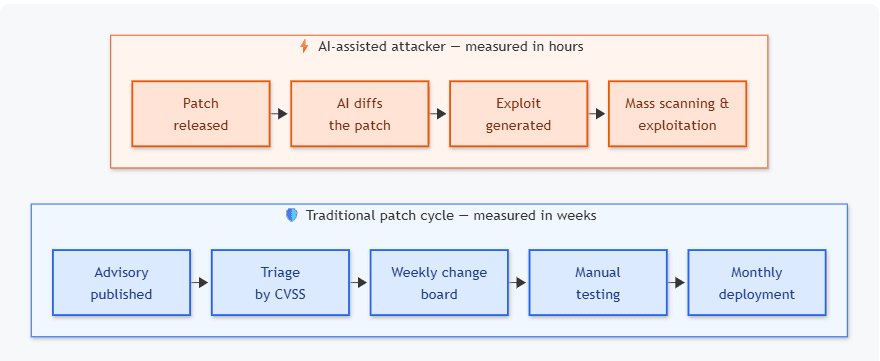
The calendar is too slow
Monthly patch cycles, weekly change boards and 30-day SLAs assume defenders have weeks before exploitation starts. They do not. Mandiant's M-Trends 2026 puts the mean time to exploit at negative seven days, so serious flaws are often attacked before a fix exists. Even improved programs struggle to keep up. Synack found average remediation time fell from 63 days to 38 in 2025, a real gain, but attackers now move within hours of disclosure.
The volume has exploded
Action1's 2026 analysis found disclosed vulnerabilities rose 92% in 2025, with remote code execution flaws up almost 130%. Microsoft's July 2026 Patch Tuesday was the largest in the program's history, at over 560 CVEs by most counts, and August's 398 CVEs was the second largest. Teams that triage by hand cannot read, rank and test that many fixes a month.
Severity scores rank the wrong things
Most programs still sort by CVSS. But a high score says how bad a flaw could be, not whether anyone is exploiting it. In Ivanti's research, 39% of IT teams said they struggle to decide which fixes to prioritize.
Too many manual hand-offs
Patching crosses security, IT operations, application owners and change management, and every hand-off adds days. In Adaptiva's 2026 survey, more than 60% of organizations still rely on manual steps somewhere in the patch lifecycle, and 74% say coordinating prioritization and remediation is their biggest security issue. Only 32% say they make full use of automation, according to Ivanti.
Blind spots and long tails
You cannot patch what you cannot see. Adaptiva found 74% of organizations have been hit by vulnerabilities in third-party applications, yet only 49% include those applications in their patch process. Network appliances are worse still: Microsoft Security Research found their median time to fix exceeds a year, against about two weeks for Windows workstations.
People are worn out
Ivanti found 62% of IT professionals feel overwhelmed by day-to-day operations, and 23% said a colleague had quit from burnout. A strategy that depends on heroics from exhausted teams does not scale.
The AI-accelerated threat
Attackers adopted AI early, and it changed the economics of exploitation. Writing a reliable exploit used to take a skilled person days or weeks. Now much of that work can be done by a model in minutes.
The evidence has built up quickly:
- Cheap one-day exploits. In a 2024 study, GPT-4 exploited 87% of a set of 15 one-day vulnerabilities at roughly $8.80 per exploit. Models have improved a great deal since.
- Exploits at scale. The Cloud Security Alliance reports that a single session with a frontier model produced 181 working Firefox exploits.
- Exploitation within hours. Synack's 2026 report says the gap between disclosure and exploitation has narrowed to hours, and remote code execution findings rose 39% year over year.
- Before disclosure. VulnCheck found nearly 29% of newly exploited KEV vulnerabilities in 2025 were attacked on or before the day their CVE was published.
- Fast movement once inside. CrowdStrike puts average eCrime breakout time at 29 minutes, with the fastest case at 27 seconds.
AI also turns every patch into a clue. When a vendor ships a fix, attackers can diff the old and new code to find exactly what changed, then build an exploit for anyone who has not yet updated. That process, once slow and specialized, is increasingly automated. Releasing a patch can now start the clock rather than stop it.
The result is a pincer. AI is helping researchers and attackers find more vulnerabilities, which drives up patch volume, while also shrinking the time defenders have to deploy each patch.
How AI helps defenders patch faster
The same capabilities that speed up attackers can speed up every stage of the patch lifecycle. Here is where AI is already making a measurable difference.
1. Smarter prioritization
Instead of sorting thousands of findings by CVSS, AI models can combine exploit intelligence, KEV listings, exploit-prediction scores, asset exposure and business context into one ranked queue. The question changes from "what is most severe?" to "what is most likely to hurt us this week?" That alone can cut the urgent list from thousands of items to dozens.
2. Predicting which patches will break things
Fear of a bad patch is one of the main reasons teams wait. AI now tackles that directly. In March 2026 Qualys added a Patch Reliability Score that estimates how likely a patch is to cause disruption in a specific environment, so teams can deploy confident fixes immediately and stage risky ones. In July, Ivanti announced Predictive Remediation, which flags issues likely to block a patch before its SLA deadline. Both are new and their real-world results are still unproven, but the direction is clear.
3. Faster, smarter testing
Testing is the bottleneck most teams cite. AI can generate regression tests, run patches against digital twins of production systems and compare behavior before and after. Practitioners quoted by SC Media describe AI-generated tests, digital twins, controlled deployment, automated validation and automated rollback as what turns patching from a ticketing process into an operational defense.
4. Writing the fix itself
For code you own, AI can now draft the patch. In DARPA's AI Cyber Challenge, autonomous systems found 54 vulnerabilities in the final round and patched 43 of them, at an average of 45 minutes and about $152 per task. Google DeepMind's CodeMender has contributed 72 security fixes to open-source projects, some over 4.5 million lines of code, with every patch reviewed by humans before submission.
5. Shielding before the patch lands
When no fix exists yet, AI can help generate virtual patches: WAF rules, IPS signatures or application-layer controls tailored to the specific flaw. These can go live in minutes while the real patch goes through proper testing.
6. Deploying and verifying at scale
AI-driven platforms can build deployment rings dynamically. ManageEngine describes grouping endpoints by risk and behavior: a canary ring of non-critical machines with stable reboot histories, then a diverse early-adopter ring, then the general population, and finally business-critical systems. Telemetry from each ring decides whether the rollout moves on, pauses or rolls back.
The gains are real. Synack found its customers cut mean time to remediate by about 47% in 2025, and Qualys reports that 40 million of the 150 million patches it tracked were deployed autonomously.
Autonomous patch management
Autonomous patch management is a closed loop. The system detects a vulnerable asset, decides whether and how urgently to act, tests the fix, deploys it in stages, verifies the result and rolls back if something breaks. It does this within policies humans set in advance, rather than waiting for a person to approve each step.
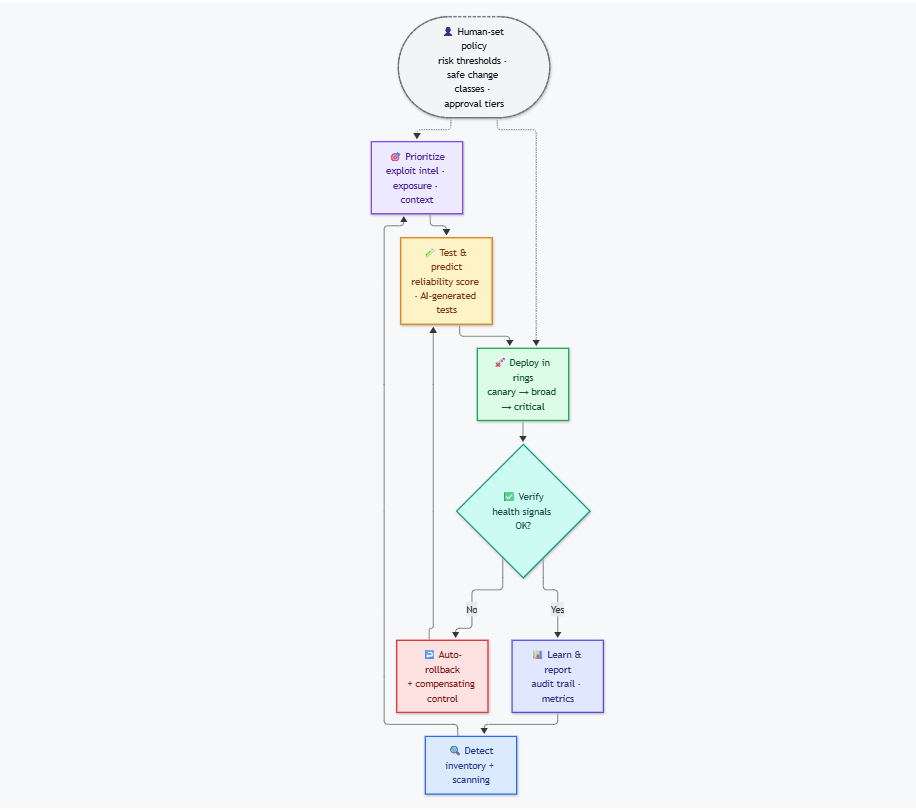
The key shift is from approving every patch to approving the policy once. Humans decide what kinds of change are safe to automate, what risk thresholds apply and where they want to stay involved. The machine handles the volume.
Most organizations are still early on this journey. In Adaptiva's 2026 survey, 44% have partially automated workflows, but only 8% report fully autonomous execution, and another 21% expect to get there soon. The good news is that speed is already improving. The share deploying patches within six days rose from 15% in 2023 to 59%.
A practical way to think about the journey is a five-level maturity model:

| Level | What it looks like | Human role |
|---|---|---|
| 0. Manual | Spreadsheets, tickets and hand-run deployments on a monthly cycle | Does everything |
| 1. Scripted | Tools push patches on a schedule; prioritization is still by CVSS | Decides and approves every batch |
| 2. Risk-based | Exploit intelligence and asset context drive priority; exploited flaws get a fast lane | Approves high-risk changes; routine updates flow automatically |
| 3. AI-assisted | AI predicts patch reliability, builds rings, generates tests and recommends actions | Reviews recommendations and handles exceptions |
| 4. Autonomous | Closed loop from detection to verification within pre-approved policy, with automatic rollback | Sets policy, audits outcomes, owns the hard cases |
You do not need to reach level 4 everywhere. The right target is different for a fleet of laptops than for a hospital's clinical systems or a factory's control network. The goal is to push as much of the routine, predictable work as possible to the higher levels, so human attention goes where judgment is really needed.
Guardrails: autonomy without recklessness
The biggest objection to autonomous patching is simple: what if the machine breaks production? It is a fair concern. Microsoft's September 2026 cumulative updates reportedly caused widespread Remote Desktop Services failures on Windows Server 2019, 2022 and 2025. Because many fixes shipped together, teams struggled to isolate which one was to blame.
The answer is not to slow down. It is to build safety into the loop.
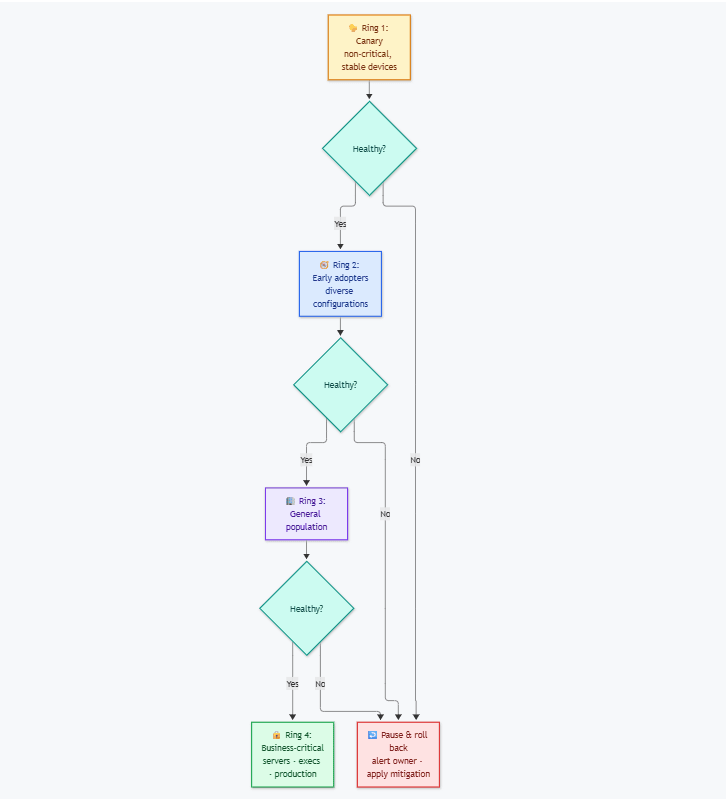
- Deployment rings and canaries. Every patch goes to a small, representative group first. Wider rollout happens only when telemetry stays healthy.
- Automatic rollback. If crash rates, failed services or performance metrics move beyond a threshold, the system pauses and reverts without waiting for a person.
- Blast-radius limits. Cap how many systems any single automated action can touch at once, and stagger changes to critical services.
- Policy tiers. Routine, well-understood updates flow automatically. High-risk changes to business-critical systems get a staged rollout and a human check. Exploited vulnerabilities get an emergency path with compensating controls if patching would be too disruptive.
- Isolate variables where you can. When a large batch lands, stage the most critical fixes separately so a failure can be traced to its cause.
- Audit everything. Every automated decision should leave a record of what was patched, why, what was observed and what was rolled back. That record is what earns trust from auditors and from your own leadership.
Humans still matter, just in different places. Automated tests only check what someone already thought to test. The NinjaOne analysis argues for reserving real human review for the changes carrying the most risk, rather than a rubber-stamp approval on every patch. That is the right balance: machines for volume and speed, people for judgment and the unexpected.
Getting started: a 90-day roadmap
You do not need to rebuild your program overnight. A focused 90 days can move most organizations up a level or two.
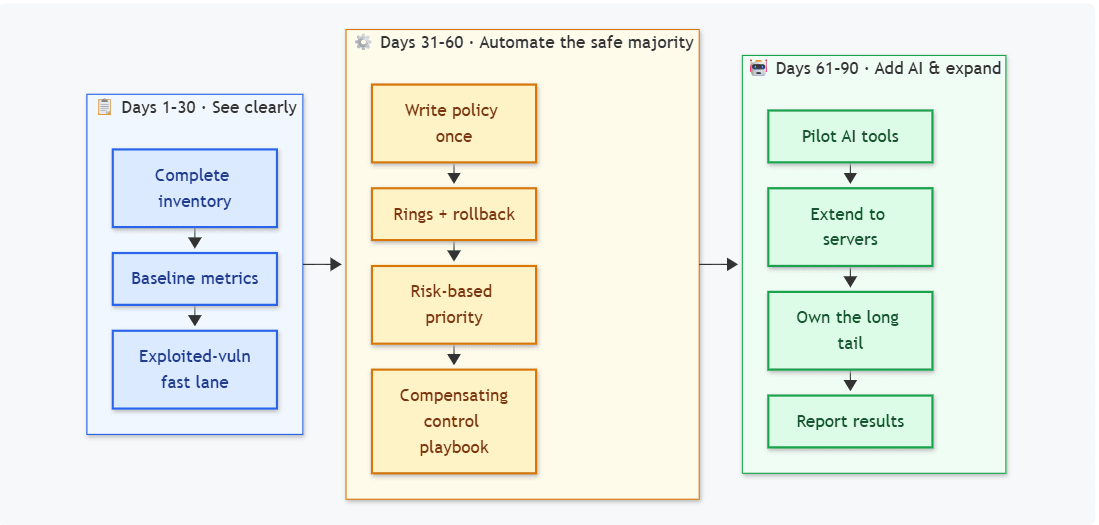
Days 1 to 30: see clearly and set the baseline
- Build a complete inventory, including third-party applications, cloud workloads and edge devices. You cannot automate patching for assets you do not know about.
- Measure where you are today. Track median and 90th-percentile time to patch, broken out by asset type, and the number of open KEV-listed vulnerabilities by age.
- Create an exploited-vulnerability fast lane with an SLA in hours or days, separate from the standard cycle.
Days 31 to 60: automate the safe majority
- Write the policy once. Agree with IT operations and change management which update classes can deploy automatically, such as browser, OS and common application updates on standard endpoints.
- Set up rings and rollback. Define canary and early-adopter groups, health signals to watch and automatic rollback thresholds.
- Switch prioritization to risk-based, combining exploit intelligence, exposure and asset criticality instead of CVSS alone.
- Prepare compensating controls for the vulnerability classes you see most, so you can shield systems before patches arrive.
Days 61 to 90: add AI and expand
- Pilot AI-assisted tools for patch reliability prediction, test generation or remediation recommendations on one asset group.
- Extend automation to servers, starting with non-critical tiers, using the same ring-and-rollback approach.
- Give every remaining asset an owner, especially appliances and legacy systems that sit outside automation.
- Report the before-and-after. Show leadership how time to patch, open exploited vulnerabilities and team hours changed. That evidence funds the next phase.
The bottom line
Patching used to be a maintenance chore. In the age of AI it is a race, and the other side is already running on machines. Monthly cycles, CVSS-only queues and per-patch approvals were reasonable answers to a slower threat. They are not reasonable answers now.
AI does not make patching safe by magic, and it does not replace the people who understand your systems. What it does is take the volume off their plate. It ranks the right work, predicts what will break, tests faster, deploys in safe stages and rolls back on its own when something goes wrong. That frees human judgment for the changes that really need it.
The organizations that come out ahead will not be the ones that patch everything instantly. They will be the ones that patch the right things first, automate the safe majority with confidence, and keep humans in charge of the policy rather than the paperwork.
Where is your patch program on the maturity curve today, and what is stopping you from moving one level up?