


What is Autonomous Endpoint Management? Why organization needs to move to Autonomous Operations?
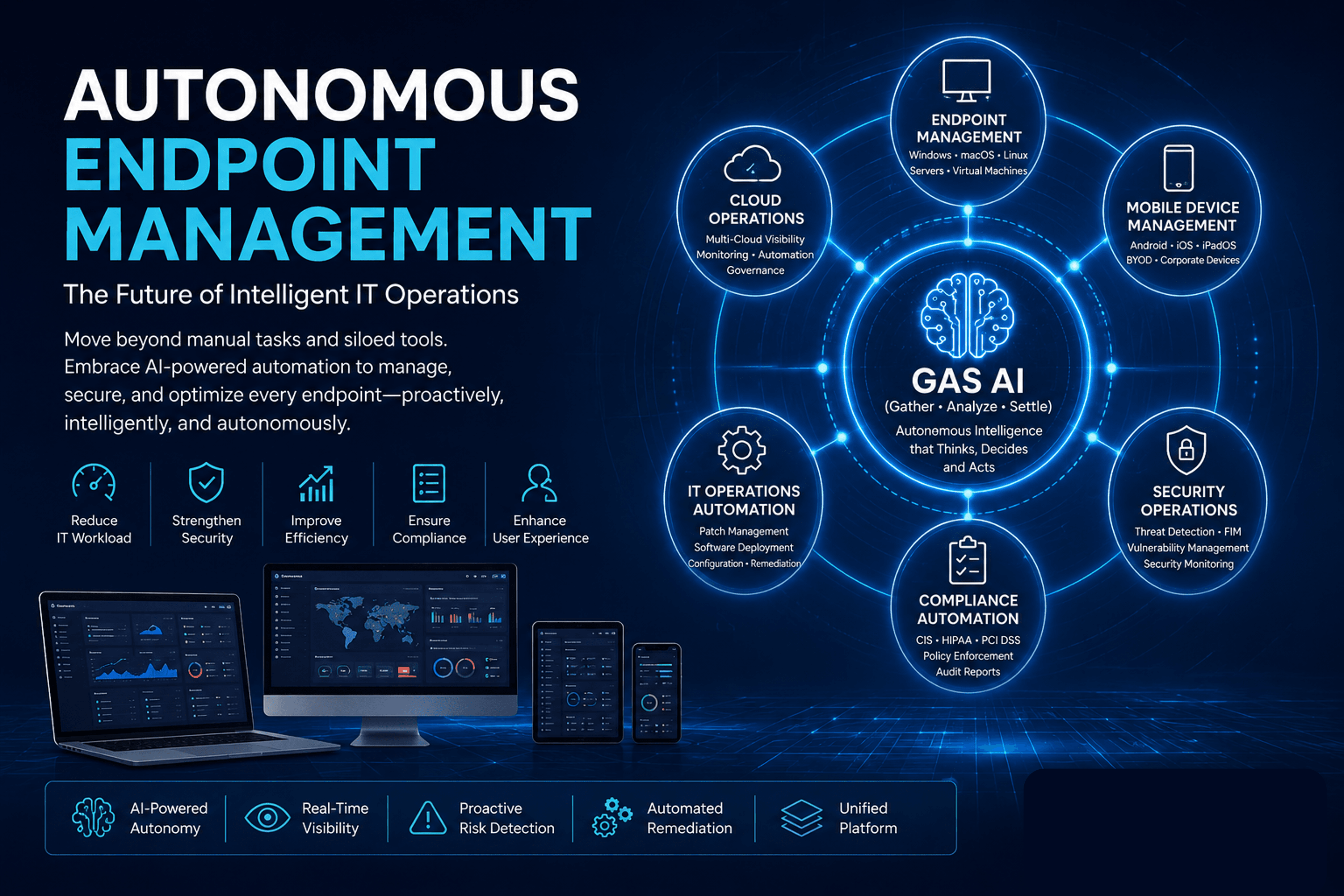
Traditional Endpoint Management solutions were designed for a different era. They rely heavily on manual administration, scheduled maintenance, reactive monitoring, and human intervention. As IT environments continue to grow in size and complexity, these approaches are no longer sustainable. This is where Autonomous Endpoint Management is changing the game.
Autonomous Endpoint Management: The Future of Intelligent IT Operations
Why Traditional Endpoint Management Is No Longer Enough
The modern workplace has transformed dramatically. Employees work from offices, homes, client locations, and virtually anywhere with an internet connection. Organizations now manage thousands of laptops, desktops, servers, virtual machines, mobile devices, and cloud-connected endpoints across distributed environments.
While digital transformation has improved business agility, it has also introduced unprecedented complexity for IT teams. Administrators are expected to maintain security, deploy software, manage patches, enforce compliance, troubleshoot issues, and respond to security incidents often using multiple disconnected tools.
Traditional Endpoint Management solutions were designed for a different era. They rely heavily on manual administration, scheduled maintenance, reactive monitoring, and human intervention. As IT environments continue to grow in size and complexity, these approaches are no longer sustainable.
This is where Autonomous Endpoint Management is changing the game.
What is Autonomous Endpoint Management?
Autonomous Endpoint Management (AEM) is the evolution of traditional Unified Endpoint Management (UEM). It combines endpoint management, artificial intelligence, automation, analytics, and security into a unified platform capable of continuously monitoring, analyzing, and resolving endpoint issues with minimal human intervention.
Instead of waiting for administrators to identify problems and manually execute tasks, autonomous platforms proactively detect issues, evaluate risks, recommend corrective actions, and automate remediation based on predefined policies and AI-driven intelligence.
Think of it as moving from manual IT administration to self-operating IT infrastructure.
Why Organizations Need Autonomous Endpoint Management
Enterprise IT teams face several common challenges:
- Growing number of endpoints
- Hybrid and remote workforce
- Increasing cyber threats
- Patch management complexity
- Compliance requirements
- Software sprawl
- Limited IT resources
- Rising operational costs
Managing these challenges using multiple point solutions creates operational silos and increases administrative overhead. Autonomous Endpoint Management brings everything together through centralized visibility, intelligent automation, and AI-assisted operations.
The Evolution of Endpoint Management
Traditional IT Management
- Manual software deployment
- Manual patch approvals
- Spreadsheet-based asset tracking
- Reactive troubleshooting
- Multiple management consoles
- High operational effort
Unified Endpoint Management (UEM)
- Centralized device management
- Remote administration
- Policy enforcement
- Patch automation
- Software deployment
While UEM significantly improved IT operations, it still depends heavily on administrators making decisions.
Autonomous Endpoint Management
The next generation introduces intelligence. Autonomous platforms continuously:
- Gather operational data
- Analyze endpoint health
- Detect anomalies
- Identify vulnerabilities
- Prioritize risks
- Recommend actions
- Automate remediation
- Learn from operational patterns
The result is faster response times, reduced manual effort, and improved endpoint resilience.
Key Capabilities of Autonomous Endpoint Management
Intelligent Asset Discovery
Organizations cannot secure what they cannot see. Autonomous Endpoint Management continuously discovers and inventories:
- Windows devices
- macOS devices
- Linux systems
- Servers
- Virtual machines
- Mobile devices
- Installed software
- Hardware assets
- Certificates
- Network-connected endpoints
Real-time visibility enables accurate asset management and informed decision-making.
AI-Powered Endpoint Monitoring
Rather than relying on periodic health checks, autonomous platforms continuously monitor endpoint activity. This includes:
- System performance
- Hardware health
- Application behavior
- Security events
- Patch status
- Compliance posture
- Resource utilization
- Configuration changes
AI analyzes this telemetry to identify potential issues before they impact users.
Autonomous Patch Management
Unpatched systems remain one of the leading causes of successful cyberattacks. Autonomous platforms streamline patch management by:
- Detecting missing updates
- AI driven Prioritizing critical patches
- Scheduling deployments
- Validating installation success
- Monitoring compliance
- Autonomous Progressive Patch updates
This reduces vulnerabilities while minimizing operational disruption.
Intelligent Software Management
Managing software across thousands of devices can become overwhelming. Autonomous Endpoint Management enables IT teams to:
- Deploy applications remotely
- Update software automatically
- Remove unauthorized applications
- Standardize software versions
- Monitor software usage
- Reduce licensing waste
Continuous Compliance
Organizations must continuously comply with industry regulations and internal security policies. Autonomous platforms simplify compliance through:
- Automated policy enforcement
- Configuration monitoring
- Compliance scoring
- Audit-ready reporting
- Continuous assessments
- Automated remediation
This reduces audit preparation time while improving governance.
Integrated Security Operations
Modern endpoint management cannot operate separately from cybersecurity. Autonomous Endpoint Management integrates security directly into operational workflows.
Capabilities include:
- Vulnerability monitoring
- File Integrity Monitoring
- Application control
- Certificate monitoring
- Threat detection
- Audit logging
- Security analytics
- Policy enforcement
Instead of switching between multiple tools, security and IT teams operate from a single platform.
AI: The Brain Behind Autonomous Operations
Artificial Intelligence transforms endpoint management from reactive administration into proactive operations. With Agentic interface IT and Security team saves lots of time. Its an era of No CLickOps where MTTD and MTTR is significantly reduce from single agentic interface.
AI continuously: Gather Collect endpoint telemetry, inventory, security events, performance metrics, and operational data. Analyze Correlate events, identify anomalies, detect vulnerabilities, evaluate risk, and predict potential failures. Settle Recommend or automatically execute remediation actions such as deploying patches, restarting services, enforcing policies, or notifying administrators.
This intelligent workflow dramatically reduces Mean Time to Detect (MTTD) and Mean Time to Resolve (MTTR).
Benefits of Autonomous Endpoint Management
Organizations adopting autonomous operations experience measurable improvements.
Improved Operational Efficiency
Automation reduces repetitive administrative tasks, allowing IT teams to focus on strategic initiatives.
Faster Incident Resolution
AI-driven insights help identify root causes quickly, reducing downtime.
Stronger Security
Continuous monitoring and automated remediation minimize security exposure.
Better Compliance
Policy automation simplifies regulatory compliance and audit readiness.
Lower IT Costs
Consolidating multiple management tools into a single platform reduces licensing costs and operational complexity.
Enhanced User Experience
Healthy, secure, and consistently updated devices improve employee productivity.
Why Autonomous Endpoint Management Matters for Hybrid Work
Hybrid work environments continue to expand the attack surface. Employees connect from:
- Home networks
- Public Wi-Fi
- Branch offices
- Customer locations
- Remote sites
Autonomous platforms ensure that every endpoint remains visible, compliant, patched, and secure regardless of location.
The Future of Endpoint Management
Endpoint management is rapidly evolving beyond simple device administration. Future platforms will increasingly leverage:
- Artificial Intelligence
- Machine Learning
- Autonomous Remediation
- Predictive Analytics
- Self-Healing Endpoints
- Natural Language IT Assistants
- Unified Security Operations
- Intelligent Automation
Organizations investing in autonomous operations today will be better prepared for tomorrow's digital workplace.
Why Trinetri Autonomous Platform?
The Trinetri Autonomous Platform is built to help organizations move beyond traditional endpoint management. Powered by GAS AI (Gather • Analyze • Settle), Trinetri combines Autonomous Endpoint Management, Cloud Operations, Mobile Device Management (MDM), Security Operations (SecOps), Compliance, Vulnerability Management, and Intelligent Automation into one unified platform.
Key capabilities include:
- Autonomous Endpoint Management
- Cloud Infrastructure Management
- Mobile Device Management
- AI-Powered Operations
- Cross-platform Patch Management
- Vulnerability Management
- Automated Compliance
- Software Deployment
- Asset Management
- Real-Time Monitoring
- Remote Endpoint Administration
- Security Operations
- Unified Dashboards
- SaaS, Private Cloud, and On-Premises deployment options
See GAS AI into action. Just GAS IT NOW
With intelligent automation at its core, Trinetri enables IT teams to reduce manual effort, strengthen security, improve operational efficiency, and confidently manage modern enterprise environments from a single platform.
Conclusion
Endpoint management is no longer just about managing devices, it is about enabling resilient, intelligent, and autonomous IT operations.
As organizations continue to embrace hybrid work, cloud technologies, and distributed infrastructure, manual processes and disconnected tools will increasingly become obstacles to growth.
Autonomous Endpoint Management represents the next evolution of enterprise IT. By combining AI, automation, security, and unified management, organizations can proactively protect their digital environments, simplify operations, and empower IT teams to focus on innovation rather than repetitive administrative tasks.
The future of endpoint management is autonomous and that future is already here.